

Calcium Chloride 94% Flakes Export: Your Complete Guide to Global Markets
2026-11-03
In the fast-moving world of chemical exports, calcium chloride 94% flakes have quietly become a must-have commodity—from dust control on remote mining roads to ice melting on frozen highways. But while demand keeps climbing, the global market is far from uniform: shipping routes, packaging standards, and regional regulations can make or break a deal. That’s why Shouguang Golden Chemical has put together this no-nonsense guide. We’re cutting through the noise to show you where the real opportunities lie, what buyers actually expect, and how to avoid the costly mistakes that trip up first-time exporters. Whether you’re eyeing Southeast Asia’s booming construction sector or the Middle East’s oilfield service needs, the next few minutes will change how you approach this market.
Why 94% Calcium Chloride Flakes Keep Winning in Cold-Weather Markets
In cold-weather markets, the real test isn’t how a de-icer performs on a mild January afternoon—it’s what happens when the temperature drops below zero and stays there. Rock salt quits around 20°F, but 94% calcium chloride flakes keep melting ice down to -25°F. That gap is wide enough to keep loading docks, parking lots, and walkways open when other products simply stop working.
Purity drives the difference. A 94% concentration means less bound water and fewer impurities, so the flakes generate heat almost immediately on contact with ice. Lower-grade alternatives often take longer to activate and leave behind a residue that turns into a slick film as temperatures swing. With 94% flakes, the reaction is faster and the coverage per pound is higher, which reduces the number of reapplications crews need to make in a single storm.
Handling and storage also favor this form. Flake calcium chloride spreads evenly, resists clumping in the hopper, and doesn’t drift off-target like fine powders. For logistics managers who have to keep winter operations running on tight schedules, that reliability—combined with lower usage rates than bulk rock salt—is why the 94% option keeps taking market share season after season.
Where Global Demand Actually Concentrates: A Field-Level View
Global demand rarely spreads evenly across sectors or regions. Instead, it clusters into a handful of dense nodes shaped by infrastructure, specialized labor, and legacy supply chains. Semiconductor fabrication, for instance, remains overwhelmingly concentrated along a narrow coastal corridor in East Asia, while high-purity quartz for crucibles comes from a single dominant deposit in North Carolina. These concentrations are not accidents of geography alone; they reflect decades of capital accumulation and technical know-how that are difficult to replicate quickly.
A field-level view also reveals hidden pockets of demand that aggregate statistics tend to smooth over. While digital services are consumed everywhere, the energy demand from data centers is heavily concentrated in a few zones: northern Virginia, Ireland, and a small number of Nordic municipalities with abundant renewable power and cool climates. Likewise, demand for advanced medical imaging equipment is not proportional to population but clusters in markets with aging demographics, high reimbursement rates, and dense networks of specialist physicians.
Recognizing these concentrations matters because diffuse attention usually leads to resource misallocation. Supply chain planners and investors who map demand at the field level can identify genuine bottlenecks before they become crises, whether that means securing rare processing gases for chip fabrication or anticipating concentrated demand for grid-scale battery storage in a handful of industrial corridors. The real opportunities lie not where demand appears on a world map, but where it actually pools.
Purity Claims, Moisture Uptake, and What Buyers Really Check
A purity number on paper rarely survives contact with a humid warehouse. Many buyers glance at “99% purity” and move on, but the remaining 1% is where the real story lives—trace chlorides, sulfates, or residual process water that can alter how the material behaves downstream. If the certificate of analysis doesn’t state the test basis (dry, as-is, or anhydrous), the claim is nearly meaningless for hygroscopic products.
Moisture uptake is not just a storage headache; it changes dosing accuracy and reaction rates. A product that pulls in 3% water during transit can throw off a formulation by more than the purity variation itself. Smart buyers spread a thin layer on a tray at ambient humidity, weigh it after a few hours, and compare that to the promised moisture sorption profile. If the vendor can’t provide sorption data under realistic conditions, the purity claim deserves a second look.
What actually gets checked at receiving is often narrower than the spec sheet suggests: presence of free water on the bag walls, clumping in the first few scoops, and a quick Karl Fischer titration on a grab sample. The line “meets 99% purity” means little if the lot-to-lot moisture swing is wide enough to cause caking or off-spec batching. Buyers who have been burned once will always ask for a retention sample and the exact analytical method—because purity and moisture are two sides of the same functional coin.
Export Documentation and Compliance Without the Usual Confusion
Export paperwork often gets treated like a cryptic ritual, but the confusion usually comes from mismatched details rather than missing documents. A commercial invoice that shows a different consignee than the bill of lading, or a certificate of origin that lists the wrong HS code, will trigger delays far more often than an absent form. The first step to cutting through the noise is to make every document repeat the same exact facts: buyer name, goods description, value, and country of origin.
Instead of chasing each requirement as a surprise, build a simple pre-shipment checklist that sorts documents by destination and trade agreement. For example, shipments to Canada under USMCA need a certification of origin only if the goods qualify and exceed a certain value, while the EU often asks for a commercial invoice with an EORI number. Knowing which box applies to your specific route removes most of the guesswork and lets you prepare files in parallel instead of scrambling at the last minute.
Compliance is not a one-time audit but a habit of catching small inconsistencies before they become customs holds. Keep a running log of the errors that actually slowed you down, whether it is a unit price that did not match the purchase order or a packing list that used a different weight than the airway bill. Turn those recurring mistakes into a final five-minute review, and the once-confusing export process starts to feel like a routine worth trusting.
Packaging and Logistics Moves That Protect Margins
Smart packaging choices go beyond just keeping products safe—they directly shape your bottom line. Swapping rigid containers for flexible pouches, or rethinking box dimensions to reduce empty space, can cut material costs and lower freight charges without compromising protection. The key is treating every inch and ounce as a negotiable expense, not a fixed given.
On the logistics side, consolidating less-than-truckload shipments into fuller loads and renegotiating carrier contracts based on actual volume patterns often uncovers hidden savings. Pairing this with a simple zone-skipping strategy—where packages bypass intermediate hubs—trims both transit time and per-unit handling fees. These moves don't require massive overhauls; they start with auditing current invoices and asking carriers for better tiered rates.
Finally, consider partnering with regional fulfillment centers instead of relying on one distant warehouse. Shorter last-mile distances mean lower delivery costs and fewer damage claims, while also giving you leverage to negotiate bulk return labels. The margin protection comes from stacking several small wins—each one modest on its own, but together they form a buffer against rising fuel surcharges and packaging material inflation.
Price Discovery and Negotiation in a Commodity That Moves Fast
In markets where the underlying commodity spoils or loses value within hours, price discovery is not a drawn-out affair. Morning auctions for cut flowers in Aalsmeer, for instance, run on a Dutch clock that ticks downward until a buyer stops it. That single moment of action is the entire negotiation: sellers have already set their initial ask based on overnight weather and shipping reports, while buyers bid by refusing to let the price fall further. There is no back-and-forth haggling; the clock itself performs the bargaining function.
Yet even with speed, negotiation is present, just compressed. A fish wholesaler at Tokyo's Toyosu market may adjust a frozen tuna price three times in ten minutes as rival buyers circle the same lot. Sellers read body language, the pace of bidding, and inventory levels visible on the floor. If a buyer hesitates, the price may be lowered slightly; if two buyers signal interest at once, a brief standoff can push the final number back up. These micro-negotiations happen without words, relying on gestures and the rhythm of the auctioneer's call.
The real challenge is that fast-moving commodities leave little room for correction. A strawberry grower who sets the morning floor price too high risks unsold pallets by noon, when heat and handling have already reduced quality. Conversely, pricing too low forfeits margin that cannot be recovered later in the day. Successful traders therefore treat negotiation as a real-time data exercise: every completed transaction updates their mental model for the next lot, and the "negotiation" is essentially a continuous recalibration against shifting supply, demand, and freshness.
FAQ
The 94% concentration offers a reliable balance between purity and handling cost, which keeps freight charges reasonable while still meeting the de-icing, dust control, and drilling fluid specs that most buyers require. Flakes also store and meter more easily than powders in cold climates.
Canada, the United States, Saudi Arabia, and several northern European countries tend to buy heavily, largely because of road de-icing programs and oilfield activity. In the Middle East, demand often shifts toward drilling and completion fluids rather than winter maintenance.
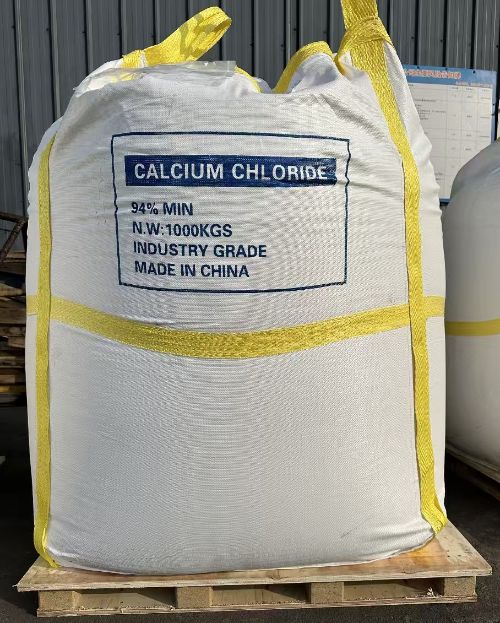
Heavy-duty woven polypropylene bags with an inner moisture barrier are the most common choice, usually in 25 kg or 50 kg sizes. Some bulk buyers prefer supersacks or loose bulk in containers, but that depends on whether the destination port has the right discharge equipment.
Ask for a certificate of analysis from a third-party lab that reports calcium chloride content, magnesium and alkali metal impurities, and moisture level. It is also worth checking the sieve size distribution, because inconsistent flake sizing can cause clumping and handling problems for the buyer.
Registration requirements under chemical safety programs, labeling rules for hazardous or irritant materials, and strict documentation for customs clearance are common friction points. Some markets also require a local importer of record or specific test reports before the cargo can be released.
Orders spike before winter in colder regions as municipalities and logistics companies stockpile de-icing supplies, which can tighten shipping capacity and push freight rates up. Exporters who secure warehouse space near destination ports during the off-season can often capture better margins.
Keep an eye on raw material availability, energy costs for drying and flaking, container freight rates, and currency swings. Competition from substitute de-icers like magnesium chloride or liquid brines also puts downward pressure on price when buyers can switch easily.
Road maintenance and dust suppression are the biggest volume drivers, followed by oil and gas drilling where calcium chloride is used in completion fluids and brine systems. Food-grade and industrial additive applications are smaller but often more stable and less price-sensitive.
Conclusion
Calcium chloride 94% flakes continue to dominate cold-weather markets not because of branding, but because their exothermic reaction and ice-melting capacity outperform lower-purity alternatives at temperatures where other deicers simply stop working. Buyers in snowbelt regions and high-altitude logistics corridors have learned that a spec sheet claiming 94% purity means little unless the moisture uptake is controlled and the flake structure remains free-flowing after weeks in storage. Field-level demand clusters around road maintenance authorities, oilfield service operators, and concrete accelerant users, each with distinct tolerance for particle size, packaging weight, and trace impurities. The real differentiator for exporters is not just meeting a chemical assay, but ensuring that what arrives in Rotterdam or Busan performs identically to the sample tested in Qingdao or Mundra.
Export documentation rarely fails for lack of knowledge—it fails because sellers conflate different destination requirements under one generic certificate of analysis. Smart shippers treat compliance as a negotiation tool: a pre-cleared MSDS and a correctly coded HS line can shave days off customs holds, which matters more than a one-dollar-per-ton price swing in a fast-moving commodity. Packaging decisions, from 25kg woven bags with inner liners to bulk supersacks, directly influence landed cost and handling damage, and buyers increasingly factor palletization and container load stability into their purchase orders. Price discovery in this market rewards those who can read regional inventory cycles and anticipate tender timing rather than chasing spot fluctuations. The exporters who win long-term contracts are the ones who make the buyer's logistics team look competent—not the ones with the flashiest brochure.
Contact Us
Contact Person: Tom Cui
Email: [email protected]
Tel/WhatsApp: +8618663670626
Website: https://www.jinjigoldenchem.com