

China Busbar Insulator: A Practical Guide to Selection and Application
2026-09-20
Every busbar insulator looks fine in a product photo. Then humidity creeps in, partial discharge starts, and a routine panel becomes a midnight failure. That gap between buying a component and engineering it into a system is especially wide when sourcing from China, where specs can look identical but behave very differently. This guide cuts through that uncertainty. We’ll show you how to read material grades, match creepage distances to actual operating conditions, and avoid the mounting mistakes that shorten service life. MOLDVOLT is built around these details—not as upsells, but as non-negotiables.
What Separates Dependable Chinese Busbar Insulators from the Rest
What separates dependable Chinese busbar insulators from the rest often starts before the mold closes. The resin system matters more than most buyers realize. A dependable supplier uses a matched epoxy or unsaturated polyester formulation with the right filler loading and a coupling agent that keeps the interface between filler and resin stable under heat. Cheaper versions may look identical but tend to develop microcracks after a few thousand thermal cycles because the resin was under-cured or the filler was not dried properly. That difference shows up later as tracking or a drop in insulation resistance, not on a quick visual check.
The next differentiator is how the insulator behaves after it leaves the press. Dependable Chinese manufacturers machine critical seating surfaces to tight tolerances instead of relying on as-molded dimensions. They also run partial discharge tests on each production lot, not just on samples pulled for a type test certificate. Some will take random parts through a -40°C to 105°C thermal shock cycle and then re-check the dielectric strength. That kind of process catches weak spots that a simple hipot pass would miss.
Lot-to-lot consistency is where many low-cost suppliers fail. A dependable partner can trace the raw material batch, mixing time, mold temperature, and post-cure schedule for any given shipment. They keep that data even after delivery, and they are willing to share it when there is a field issue. That does not mean zero defects, but it means the failure mode is usually predictable and the supplier will stand behind the data instead of disappearing after the first reorder.
Choosing the Right Insulator Material for Your Busbar's Actual Load and Climate
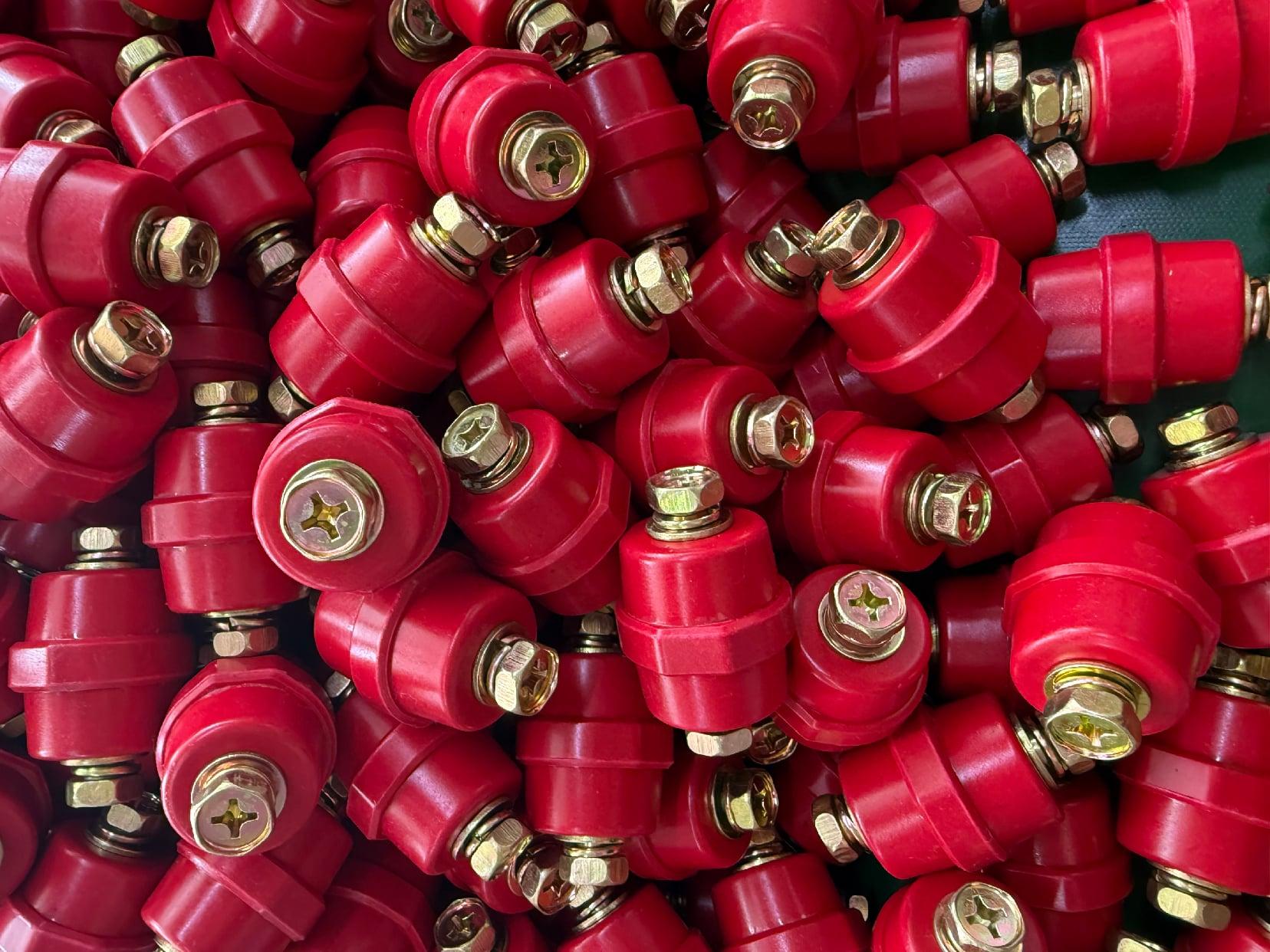
Busbar insulators rarely fail all at once, but they do degrade in ways that track closely with how much current actually flows and what the surrounding air does to them day after day. A heavily loaded busbar runs warm, sometimes hot enough to soften or embrittle polymers that looked fine in a catalog. In dry, clean indoor settings, that may push you toward epoxy or polyester glass laminate for their mechanical stiffness and moderate heat tolerance. But put the same busbar in a coastal substation with salt fog, and those materials can develop surface tracking long before the mechanical limit is reached. Matching the insulator to the real operating temperature band matters more than chasing a generic high strength rating.
Climate adds a second layer that many load-focused decisions miss. High humidity plus industrial dust creates a conductive film on insulator surfaces, favoring materials with hydrophobic behavior like silicone rubber or cycloaliphatic epoxy. In freezing climates, thermal cycling from load changes can crack rigid porcelain or glass if the busbar expands and contracts sharply. For very hot, UV-heavy regions, some polymers chalk and lose surface resistivity unless they contain stabilizers or are naturally UV-resistant. The practical approach is to first measure the busbar's steady-state temperature at peak load, then check the site's pollution level, condensation patterns, and temperature swings. Choose a material that keeps its surface resistivity high under those specific stresses, not one that simply meets a generic standard.
Installation Pitfalls That Quietly Undermine Busbar Insulator Performance
Uneven bolt torque tops the list. Threaded inserts molded into the insulator body are not designed to absorb the clamping force of an impact wrench. A few extra Newton-meters can start hairline fractures in epoxy or porcelain that stay invisible until load cycling opens them up. Then moisture gets in, partial discharge follows, and the insulator fails long before its rated life. On the other end, under-torquing leaves enough slack for micro-movement at the base, which wears the mounting surface and loosens the joint over time.
Forced alignment is another quiet killer. When the busbar holes don't line up with the insulator studs, some crews pry the bar into position and tighten it down. That bends the insulator in a way it was never meant to carry. Porcelain and cast resin parts handle compression well but crack under sustained bending or shear. The stress may not show immediately, but vibration from normal operation works on the hairline crack until the insulator snaps during a fault or even routine maintenance.
Cleanliness during installation rarely gets the attention it deserves. Fingerprints, cutting oil, metal shavings, and general grime settle on creepage surfaces. Once energized, that contamination reduces the effective creepage distance and can create tracking paths under humid conditions. A quick wipe with isopropyl alcohol and a lint-free cloth before final torque-down is cheap insurance against a flashover that gets blamed on the insulator rather than the installation.
Reading Between the Lines of a Busbar Insulator Datasheet from China
A datasheet from a Chinese busbar insulator supplier often looks straightforward at first glance—voltage ratings, creepage distances, material specs. But the real story hides in what is not printed on the front page. Look closely at the test conditions: a 12 kV insulator might be rated under dry, clean conditions, yet your installation sits in a coastal substation where salt fog eats away at epoxy surfaces within months. The fine print about comparative tracking index or UV resistance barely gets a footnote, but that is exactly where field failures start.
Another layer worth reading between the lines is the lifetime expectation hidden behind vague phrases like ‘high mechanical strength’ or ‘excellent aging performance.’ A honest Chinese manufacturer will provide bending load curves and thermal cycling data upon request; one that hesitates likely tested only at room temperature or omitted the low-temperature brittleness case. Pay attention to the batch number and date code format as well—consistent traceability says more about production discipline than any glossy certification logo.
Finally, compare the dimensional tolerances against IEC or GB standards, not the supplier’s own brochure. A 2 mm creepage shortfall on paper can become a 15% safety margin loss in a polluted environment. Smart buyers request the full type test report, not just the summary page, and verify whether the data was generated by a third-party lab or self-certified. That is the difference between a datasheet written for marketing and one written for engineers who will actually install the busbar.
Application-Specific Matching: From Compact Switchgear to Outdoor Substations
Matching electrical equipment to the exact demands of a site is rarely a one-size-fits-all exercise. A compact switchgear unit, for instance, must balance tight spatial constraints with thermal dissipation and cable access. You might choose a gas-insulated design for a basement substation, not because it is the default option, but because the reduced footprint and sealed enclosure align with the physical reality of the room. The same logic applies when you step outside: an outdoor substation on a coastal site demands enclosures that resist salt-laden air, while a desert location pushes you toward ventilation strategies that cope with fine dust and extreme temperature swings.
Careful matching also means looking beyond the primary ratings. Two feeders may share identical voltage and current specs, yet one serves a sensitive manufacturing line with frequent motor starts, and the other feeds a largely resistive heating load. The harmonic profile, inrush behaviour, and required switching duty will differ enough to influence busbar sizing, relay settings, and even the choice between withdrawable and fixed breaker designs. Getting this right is not about adding margin for its own sake; it is about understanding the load's personality and selecting equipment that lives comfortably with it over a decade or more.
Outdoor substations add another layer: environmental exposure becomes a design input rather than an afterthought. Bushings, surge arresters, and disconnectors must be specified for pollution levels that change with prevailing winds and nearby industrial activity. Even the orientation of a transformer's radiators can matter, as prevailing wind can either aid cooling or push hot air back into the enclosure. By treating each application as a unique set of constraints rather than a generic template, engineers avoid the twin traps of over-specifying costly equipment and under-specifying components that fail early in the field.
Field Checks and Quality Signals When Sourcing Busbar Insulators from Chinese Factories
Rather than relying on datasheets, inspect the raw epoxy or polyester compound batches on the floor. Ask to see incoming resin certificates and check storage conditions—excess humidity in the warehouse often leads to porosity after curing. Look at the cure oven temperature logs for consistency; a factory that cannot show batch-level records is hiding something. A stronger signal is traceability from resin lot to molded part, with date codes engraved on the insulator body, not just stamped on packaging.
Dimensional checks need to go beyond a caliper. Bring go/no-go gauges for busbar slot widths and insert spacing, then compare them against your actual copper bar dimensions. Measure flatness of long insulators on a granite table; anything over 600mm will often show warpage above 0.3mm, which prevents proper busbar seating. Torque-test threaded inserts to rated values—if a brass insert spins in the epoxy, the preheating or mold design was rushed. Check mounting hole positions using a drill jig, not a tape measure.
Ask to witness a thermal shock test: take a production sample from a 150°C oven into cold water, then inspect for cracks or delamination at the metal-to-resin interface. A factory that hesitates usually has insulation material problems. Also look at finished goods packaging—individual foam separation and no moisture-trapping plastic bags indicate process maturity. Pull random parts from the finished goods area rather than the showcase table; if they refuse, treat that as a quality signal in itself.
FAQ
For humid, salty environments, skip standard creepage distances. Look for insulators with a specific creepage of at least 25 mm/kV and preferably hydrophobic silicone rubber or cycloaliphatic epoxy housings. Also check for corrosion-resistant metal inserts and ask the supplier for salt fog test reports rather than just routine type tests.
Porcelain offers excellent rigidity and long-term UV stability but is heavier and can shatter under mechanical shock. Epoxy resin is lighter, easier to mould into compact shapes, and handles vibration better. For indoor 12kV switchgear, cycloaliphatic epoxy is often the better fit because it resists cracking from thermal cycling and reduces panel weight.
Many Chinese manufacturers now produce insulators meeting IEC 60168 and IEC 60660, but reliability depends on the factory's testing discipline. Request a detailed routine test plan covering power frequency withstand, partial discharge, and mechanical bending. Also ask for third-party inspection rights before shipment. Avoid suppliers that cannot provide traceable material certificates for the resin or ceramic body.
For normal indoor conditions, the minimum creepage distance is usually 12 mm/kV for lightly polluted areas and 16 mm/kV for moderate pollution. In heavily polluted industrial zones, 20 mm/kV or more is common. However, always cross-check with the project's specific pollution class per GB/T 16935 or IEC 60815 rather than relying on a blanket value.
No. DC systems impose unidirectional electric stress that accelerates surface ageing and allows contamination to build up more quickly. A DC busbar insulator needs a longer creepage path, often 1.3 to 1.5 times the equivalent AC value, plus specially formulated housing material to prevent carbon tracking. Reusing an AC insulator in a DC circuit will likely lead to premature flashover.
Most suppliers offer two main patterns: a single central insert for bolting from one side, or a through-hole design with female threads on both ends for flexible busbar support. The flat-base type with two or four holes is popular for panel mounting. Always confirm the mechanical load rating for the exact mounting orientation, because a side-mounted busbar exerts bending moment that a top-mounted bar does not.
Ask for the full type test report, not just a certificate. A legitimate report will list the test laboratory, test dates, and specific standard clauses. Cross-check the report number with the testing lab directly if possible. For critical projects, arrange a pre-shipment inspection that includes random sampling for partial discharge and flame retardance. Watch out for manufacturers that only provide a self-declaration without any third-party test data.
Conclusion
Sourcing busbar insulators from China involves more than comparing dimensions; dependable units distinguish themselves by handling thermal cycling, partial discharge, and mechanical stress under real load rather than just passing a static test. Material choice must match the busbar's actual current and climate: epoxy resin suits indoor compact switchgear for its tracking resistance and dimensional stability, while porcelain or silicone rubber performs better in outdoor substations facing pollution, rain, and wide temperature swings. One of the quietest killers is installation: over-torqued mounting bolts, omitted flat washers, or reduced clearance to earthed metal can shave away creepage distance and invite flashover long before the datasheet suggests any weakness. When reading a Chinese supplier's datasheet, dig into the test standards—IEC 62231, GB/T 8287, or equivalent—and ask whether listed electrical values come from type tests on production samples or just routine spot checks.
Application-specific matching separates a sensible purchase from a costly misfit. Compact switchgear calls for short, rigid insulators with high cantilever strength and tight center-to-center tolerances, while outdoor substations require long creepage distances, hydrophobic sheds, and hardware that resists galvanic corrosion. During factory evaluation, inspect actual production batches rather than gold-plated samples: look for uniform glaze or polymer surface, absence of micro-cracks near metal inserts, consistent thread plating, and request a dye penetration test on a random piece. A more telling quality signal is whether the factory conducts 100% routine testing (power frequency withstand, partial discharge) or only batch sampling, and whether they can provide third-party reports from labs like KEMA, CESI, or STL members. In the end, a dependable Chinese busbar insulator is rarely the lowest bid; it is the one verified against your specific load profile, installation habits, and environmental exposure.
Contact Us
Contact Person: Hellen
Email: [email protected]
Tel/WhatsApp: 86-13634205622
Website: https://www.voltcabinet.com