

China Pipe Shot Blasting Machine Supplier for Consistent Pipe Surface Finishing
2026-11-22
Pipe coating failures rarely begin with the coating itself. They usually start with uneven surface prep—one pipe cleaned too aggressively, the next barely profiled. That inconsistency forces extra rework and weakens adhesion. PuHua designs China-built pipe shot blasting machines to remove that guesswork and deliver repeatable surface finishing. In the sections ahead, we’ll explore what to look for in a supplier and how the right machine keeps every pipe within spec.
Why Pipe Coaters Specify Adjustable Blast Pressure on Chinese Equipment
Fixed-pressure blasting rigs rarely match the surface conditions found across different pipe batches. One project may involve heavily rusted pipe with tight mill scale, while the next runs thin-wall material that deforms under excessive impact. Adjustable blast pressure gives the operator room to work between roughly 20 and 90 psi, so the same machine can remove stubborn oxide without pitting softer steel or warping lighter walls.
The practical advantage becomes clearer when abrasive consumption is tracked. Running at full pressure on every joint wastes grit, increases dust, and can embed fractured abrasive into the surface, which later interferes with coating adhesion. Being able to ease pressure down for light flash rust or ramp it up for deep pitting means the anchor profile stays within the range the coating manufacturer actually requires, rather than whatever the machine happens to deliver.
There is also a maintenance and scheduling side to it. Blast nozzles, hoses, and windows last longer when the system is not always running wide open, especially on jobs that alternate between heavy and light surface preparation. For pipe coaters handling mixed diameters and coating systems, pressure adjustment avoids stopping the line to swap out fixed orifices or wait for a different nozzle setup. That kind of flexibility is usually learned on the shop floor, and it is why adjustable pressure gets written into purchase specifications for Chinese-built blasting equipment.
Matching Abrasive Size to Pipe Wall Thickness Before the First Run
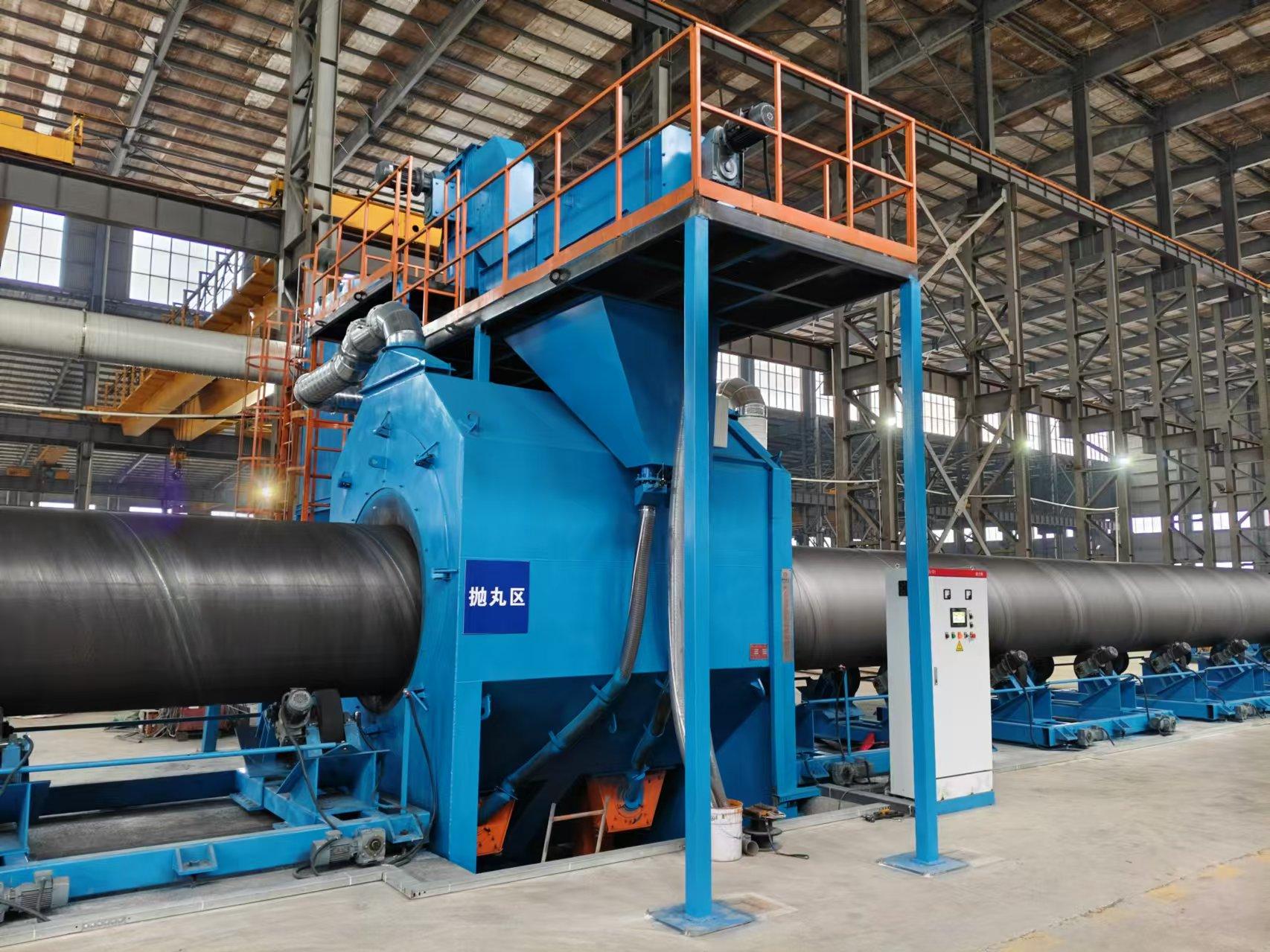
Wall thickness sets the practical limit for grit size long before the first pass enters the pipe. Thin-wall tubing tends to flex and heat up under aggressive cutting, so finer media in the 80 to 120 mesh range usually keeps the inner surface intact while still removing light oxidation. Going coarser on a 16-gauge wall might save a few minutes, but the pitting and dimensional loss that follow are rarely worth the trade.
On heavier schedule pipe, a medium to coarse grit becomes more defensible because the extra wall section absorbs the impact without eating into structural margin. The point is not simply faster cleaning; it is producing a profile depth the first coating or liner can actually lock onto. Matching the abrasive to the wall before the first run keeps rebound pressure predictable and helps avoid the uneven texture that forces a slower second pass.
Can One Blast System Hold a Repeatable Anchor Profile on Long Pipe Spans?
On long pipe spans, holding a consistent anchor profile with a single blast system depends less on the equipment's nominal rating and more on how well the blast nozzle distance, angle, and dwell time are managed across the entire length. Pipe flex, operator reach, and hose drag all shift as the work moves further from the compressor or pot, so the same settings do not always produce the same surface depth at the far end of a span.
The main repeatability problems show up as pressure drop through long blast hose runs and uneven travel speed when an operator has to reposition scaffolding or maneuver around supports. A blast pot that holds steady at the machine can lose enough air volume over a long hose to change particle velocity at the nozzle, which directly affects peak count and profile depth. If the pipe is suspended or spanning between supports, vibration can also alter the standoff distance in ways that are hard to correct by eye.
It is possible to get repeatable results with one system, but only if the setup includes some form of carriage, crawler, or rigid guide that keeps nozzle geometry stable and if the air supply is sized for the full hose length. Otherwise the profile tends to drift from one end of the span to the other, and the operator ends up compensating with technique rather than controlling the actual variables.
What Changes When You Move From Seamed to Seamless Pipe
Switching from seamed to seamless pipe changes the material's starting point. A seamed pipe begins as a flat strip or plate that is rolled and welded along its length, leaving a longitudinal joint that behaves differently from the surrounding steel. A seamless pipe is pierced from a solid billet, so the grain structure flows around the circumference without a welded interruption. That removes the weakest geometric discontinuity and gives the pipe a more uniform response to hoop stress, especially under cyclic loading or high internal pressure.
The mechanical expectations shift once the weld is gone. With seamed pipe, the heat-affected zone near the seam can have slightly different hardness, toughness, or corrosion resistance unless carefully treated. Seamless pipe avoids that local variability, which matters when the line handles aggressive media, extreme temperatures, or rapid pressure swings. However, seamless pipe is not automatically superior in every dimension. Modern welded pipe often has tighter wall thickness control, so specifying seamless means accepting a different balance between uniformity of properties and uniformity of dimensions.
Practical changes also show up in procurement, inspection, and cost. Seamless pipe typically costs more and may have longer lead times for certain sizes, but it eliminates weld seam inspection and reduces concerns about seam-related defects. Installers may find seamless easier to bend or machine because there is no weld line to work around. In many projects, the decision comes down to whether the added margin of safety under pressure justifies the higher material cost and reduced dimensional consistency.
Preventing Dust and Spent Media From Undercutting Surface Consistency
Dust and spent media settle into the profile just as the surface starts to close, which means the next pass hits a cushion of fines instead of clean substrate. That inconsistency shows up later as dull patches, uneven anchor, or coating adhesion failures that are hard to trace back to blasting. Keeping the work zone clear sounds basic, but it usually requires more than a quick sweep between runs.
One practical approach is to control media breakdown at the source. Running abrasive at slightly lower pressure for a longer dwell can maintain the cut without shattering particles as quickly, and tuning the media-to-air ratio keeps the dust burden from climbing. Where reclaim systems are in use, adjusting the air wash and ensuring screens actually separate fines before they return to the pot makes an immediate difference in what lands on the surface.
The other half is contamination at the workpiece. Dry blasting tends to drive dust into corners and rough areas, so a dedicated blow-down or vacuum pass before the final profile check helps remove what the blast itself left behind. On outdoor or field work, erecting simple windbreaks and blasting with the breeze instead of against it reduces the amount of spent media drifting back onto prepared areas. These small corrections often stabilize the anchor pattern more than switching abrasive types.
Setting Wheel Speed and Feed Rate for Mixed Diameter Pipe Batches
Mixing pipe diameters in one batch usually means choosing between constant resetting and a compromise setting that leaves some pieces overcut or underfed. A better starting point is to split the batch into two or three diameter groups instead of chasing a single magic number. For each group, set the wheel speed off the largest wall section actually being cut, not the average tube size, because the largest section controls heat buildup and tooth load.
Wheel speed needs to climb only when the smaller diameters are run separately. If small and large pipes share the same setup, keep the speed closer to the safe range for the large diameter and let the smaller pieces run slightly below their ideal surface speed. The small tube will still cut clean if the feed is steady, but pushing the wheel faster across mixed diameters often shows up as vibration at the free end of the lighter pipe or a dull ringing sound that tells you the tooth is skating instead of biting.
Feed rate is where mixed batches get damaged most. Rather than using the same feed for the whole lot, drop the feed by ten to fifteen percent on thin-wall small diameters to keep the clamp pressure from ovaling the tube. On the larger, heavier sections, keep enough feed to maintain a visible chip curl and avoid rubbing. If the batch has to run without setting changes, sort the order so the wall thickness changes gradually instead of jumping from a heavy header pipe to a light handrail tube.
FAQ
Many Chinese manufacturers have spent years refining blast wheel and recovery systems for steel pipe lines, so the equipment is built around practical production needs rather than just catalog specs. The main draw is getting a machine that delivers steady anchor profiles at lower capital cost, with local access to spare parts and engineers who understand pipe handling.
Consistency comes from controlling four variables together: blast wheel speed, abrasive flow rate, pipe travel speed, and the distance between the nozzles and the surface. When a supplier sets these correctly for a given diameter and wall thickness, the machine repeats the same impact pattern along the full length. Small drifts in any one variable usually show up quickly as patchy roughness or uneven cleaning.
Ask for references from projects using the same pipe diameter range and coating specs you work with. Request details on the abrasive recovery and dust collection system, not just the blasting cabinet. Also ask about wear parts inventory: blades, liners, and screens should be easy to replace and available without long lead times.
Most well-designed machines can handle a range of diameters through adjustable roller conveyors and movable blast heads. The key is whether the adjustments are repeatable. If operators have to realign everything manually after each size change, the finish will vary. Better setups include marked positions or motorized adjustments that return to preset values.
It plays a bigger role than people expect. If the dust collector is undersized, fine particles stay in the cabinet and mix with the abrasive stream, reducing impact energy and causing uneven cleaning. A properly sized collector keeps the cabinet under negative pressure, pulls fines away from the work zone, and helps the abrasive recycling system deliver a cleaner mix to the blast wheels.
Check blast wheel blades and impeller wear each week, inspect the abrasive recovery screens for holes or clogging, and verify the abrasive feed valve opens fully. Worn blades throw abrasive unevenly, which immediately shows up as stripes or shadows on the pipe. Keeping the media clean and the feed steady usually prevents most finish problems.
Yes. For tougher coating requirements, suppliers can change the number of blast wheels, adjust their angle, use different abrasive hardness, or add a second pass. If you need a particular anchor profile depth, share that target early and ask for a trial run on sample pipes before finalizing the configuration.
Conclusion
Consistent pipe surface finishing rarely comes down to a single machine setting. On the floor, Chinese suppliers that handle long pipe spans well tend to treat blast pressure as a working variable, not a fixed spec. Coaters adjust pressure to keep the anchor profile stable without stretching or thinning the pipe wall, and they match abrasive size to wall thickness before the first run so lighter stock does not get hammered while heavier stock still gets cleaned. That same sense of calibration shows up when the line switches from seamed to seamless pipe. Seam material reacts differently around the weld zone, and seamless pipe brings its own mill scale pattern, so feed rate, wheel speed, and nozzle angle often need a fresh baseline rather than a copy of yesterday's settings.
Another overlooked variable is the abrasive mix itself. Dust and spent media recirculating through the system can erode profile consistency faster than a wrong pressure setting. Fine dust sitting on the surface or worn grit breaking down mid-cycle leaves uneven texture, especially over long spans. Suppliers that build proper air wash systems and make media replenishment straightforward help operators keep the blast stream stable. For mixed diameter batches, the same principle applies: wheel speed and feed rate should be adjusted per diameter instead of running one standard recipe. A slower feed on smaller diameters and a higher wheel speed on thicker walls can prevent both under-blasting and over-peening. The result is less rework and a surface that holds a repeatable anchor profile from one end of the pipe to the other.
Contact Us
Contact Person: Bruce
Email: [email protected]
Tel/WhatsApp: +86 15166629468
Website: https://www.povalchina.com/