

Custom Gantry Machining Center Solutions for Precision Manufacturing
2026-06-24
In precision manufacturing, the right machining center can mean the difference between flawless production and costly errors. Custom gantry machining centers offer the flexibility to tackle complex geometries and large-scale workpieces with unmatched accuracy. At WINNRUI CNC, we engineer tailored solutions that address your unique challenges, not just off-the-shelf hardware. Ready to rethink what's possible on your factory floor?
Engineering Large-Scale Precision with Modular Gantry Systems
Achieving high precision across vast work areas is a persistent challenge in modern manufacturing. Modular gantry systems address this by combining standardized, rigid components with servo-driven motion control, allowing engineers to configure axes that span tens of meters while maintaining micron-level repeatability. Unlike traditional monolithic setups, these systems distribute loads through dual-drive beams and precision rails, minimizing deflection and thermal drift over large spans. The result is a platform where accuracy scales with size, not despite it.
The true strength of a modular gantry lies in its adaptability. Builders can select from a range of linear motor or ball screw modules, mix and match cross-axis lengths, and integrate multi-zone vacuum tables or laser displacement sensors as needed. This means a single gantry architecture might first serve as a high-speed pick-and-place cell for photovoltaic panels, then be reconfigured for precision dispensing in electronics assembly without compromising path accuracy. The plug-and-play nature of these modules also slashes integration time, letting engineers focus on process tuning rather than structural design.
In heavy industries like aerospace and wind energy, these systems prove that large-scale does not mean low-resolution. When drilling rivet holes along a forty-meter wing spar or milling the root section of a turbine blade, the gantry’s distributed encoder feedback and active gantry skew correction keep the tool tip within a few microns of its programmed trajectory. By decoupling the mechanical structure from the motion precision, modular gantries enable factories to pursue tighter tolerances on ever-larger workpieces without the exponential cost curve of custom, monolithic machines.
Adaptive Spindle Configurations for Multi-Axis Machining
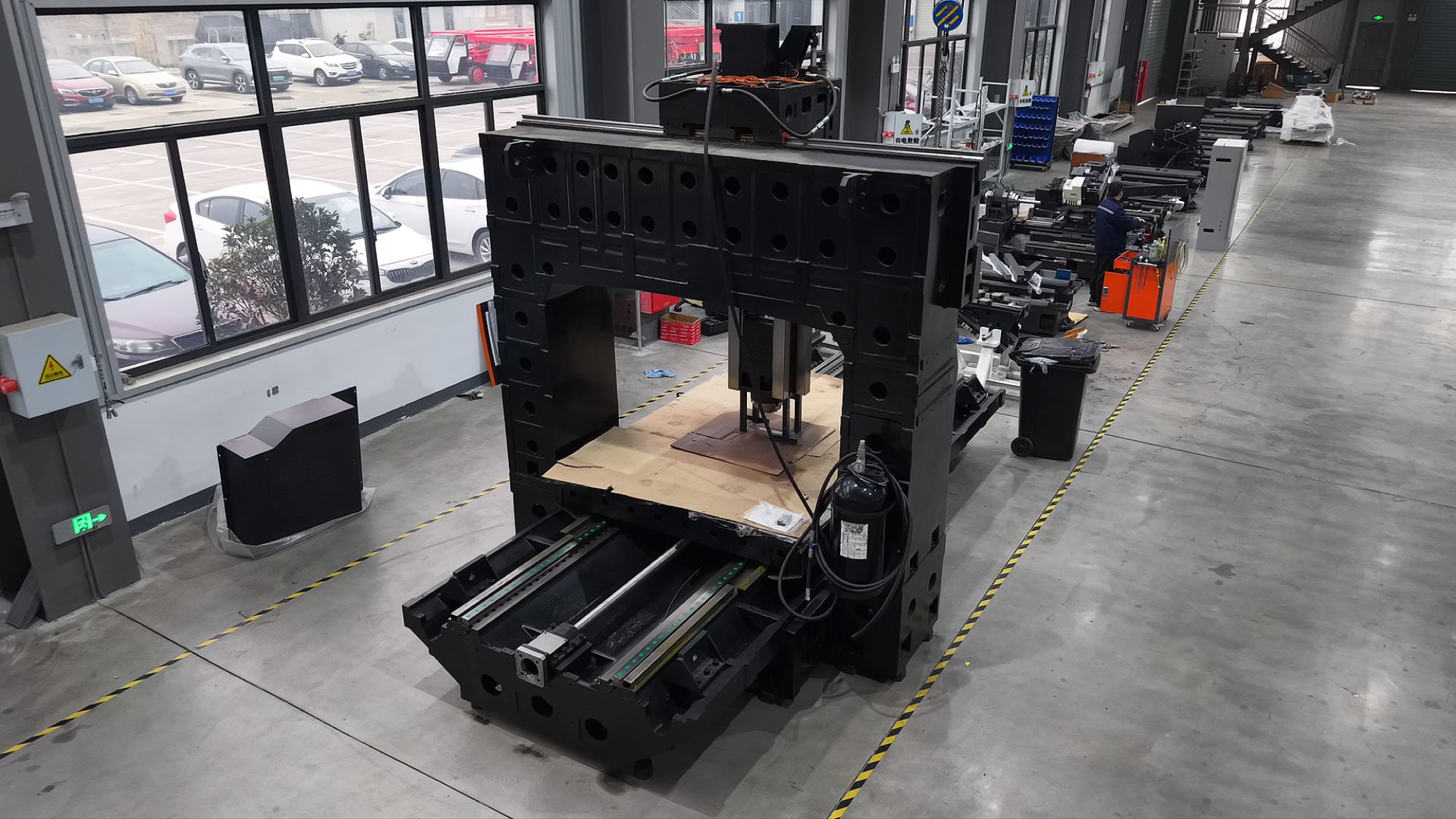
Multi-axis machines have long relied on fixed spindle setups that lock you into a narrow sweet spot for speed, torque, and tilt. Adaptive configurations break that mold by letting the spindle reconfigure itself mid-operation, responding to tool load, chatter, or even subtle material inconsistencies through embedded sensors and real-time processing. It’s a shift from brute-force rigidity to a more conversational relationship between machine and workpiece, where adjustments happen silently and continuously.
Instead of treating every pass the same, an adaptive spindle can vary its preload, damping, and sometimes even switch between high-speed and high-torque modes without stopping the cycle. On a five-axis contouring path, this means the tool stays in a stable engagement window even as the cutting vector swings wildly. The result isn’t just less chatter—you start seeing finishes that need almost no handwork, and inserts that wear evenly instead of chipping deep into a shift.
Where the idea gets really interesting is in dealing with hard-to-machine alloys and thin-walled structures. By constantly nudging the spindle dynamics, you avoid building up resonant vibrations that lead to scrapped parts. In practice, it often means you can push feed rates higher in roughing while still holding tight tolerances in finishing, all without a rigid process plan carved in stone. More shops are pairing this with tool-wear models so the spindle tunes itself to a specific insert’s behavior, effectively giving each job a tailored machine personality.
Thermal Stability and Vibration Damping in Heavy-Duty Operations
Heavy machinery in mining, construction, and manufacturing rarely gets a break. Engines and gearboxes push components to their thermal limits while constant jarring and shaking strain every joint and mount. Without robust thermal stability, heat-soaked parts lose strength, lubricants thin out, and electronics start glitching. Meanwhile, unchecked vibration wears out bearings, cracks welds, and turns precision into sloppiness that can sideline a whole operation.
Engineers tackle these twin problems with a mix of material science and clever design. High-nickel alloys and ceramic composites keep their shape under blast-furnace conditions, while variable-pressure oiling systems and directed cooling channels pull heat away from vulnerable points. For vibration, it’s not just about thicker rubber mounts. Tuned mass dampers, hydraulic bushings, and even active cancellation systems—borrowed from aerospace—get tuned to the specific frequencies that rattle a machine’s frame during hard digging or heavy lifts.
The payoff shows up in the maintenance logs and the balance sheets. When thermal expansion doesn’t seize up a pivot pin and damping keeps a driveshaft from whipping itself to death, uptime climbs without fanfare. Operators notice the difference in how a machine feels after a triple shift: smoother controls, less unexpected shutdowns, and fewer cracked lines leaking hydraulic fluid. It’s the kind of durability that doesn’t need a marketing tagline because the shop floor already knows when a rig can take the abuse.
Automated Workflow Integration for High-Volume Production
Bringing automation into high-volume production workflows shifts the entire rhythm of operations, cutting away the repetitive tasks that slow teams down. Instead of wresting with disjointed tools, the process becomes a smooth, self-correcting loop where data moves instantly between testing, assembly, and packaging stages. This kind of tight integration doesn’t just replace manual steps—it redefines how capacity scales, letting the same crew handle surges without adding extra chaos to the day.
The real payoff shows up in the details: real-time tracking that flags a drifting parameter before it turns into a bin of scrap, or a scheduling tweak that rearranges priorities based on live demand instead of a static plan. It’s less about flashy dashboards and more about the certainty that every shift ends with what was actually promised. Unexpected downtime shrinks, not because machines never fail, but because the system reroutes work in ways operators never had the bandwidth to manage on their own.
What sets a solid setup apart is how it bends to the quirks of a specific line rather than forcing a one-size-fits-all mold. A well-tuned integration learns from past bottlenecks and adjusts thresholds without someone rewriting logic each quarter. That adaptability keeps the floor moving even when product variants multiply, making it possible to push out higher volumes with the same footprint—and with fewer middle-of-the-night calls to untangle a stuck batch.
Material Versatility: From Titanium to Composites
Modern engineering constantly pushes materials to their limits, and the ability to choose from an expansive palette of substances defines what’s achievable. Titanium offers an unmatched strength-to-weight ratio and corrosion resistance, making it a natural fit for aerospace frames and medical implants. Yet its machining difficulty and cost often steer designers toward layered carbon fiber or hybrid composites when weight savings must go further.
Composites themselves have evolved far beyond simple fiberglass. Today’s advanced prepregs blend carbon, aramid, or even basalt fibers with toughened resin systems, resulting in structures that can be tuned for specific load paths and environmental conditions. This departure from isotropic metal properties allows engineers to place strength exactly where it’s needed, slashing mass without compromising safety.
The real breakthrough lies in combining these materials—multi-material architectures that exploit the best of each. A single assembly might feature composite skins bonded to a titanium spar, or 3D-printed metal brackets embedded in a thermoplastic fuselage. That kind of versatility doesn’t just improve performance; it redefines manufacturing workflows and opens the door to repair techniques that were unthinkable a decade ago.
Real-Time Monitoring and Predictive Maintenance Solutions
Modern industrial environments thrive on the ability to catch issues before they spiral into costly failures. With real-time monitoring, every vibration, temperature shift, and pressure change is tracked continuously, painting a dynamic picture of machinery health. This constant stream of data allows teams to move beyond routine checklists, focusing instead on anomalies that truly demand attention. The result is less unplanned downtime and more confident decision-making on the factory floor.
Predictive analytics built into these platforms turns historical and live data into actionable forecasts. Instead of reacting to breakdowns, maintenance schedules align with actual wear patterns and usage cycles. This shift not only extends asset life but also slashes repair expenses. It’s a smarter way to allocate resources—shipping technicians only when needed and stocking spare parts based on real probability, not guesswork.
FAQ
A gantry machining center uses a bridge-like structure where the spindle moves along a crossbeam above the workpiece, unlike traditional C-frame mills that have a cantilevered spindle. This design provides superior rigidity and stability, especially for large or heavy parts. It allows for consistent precision across the entire work envelope, making it ideal for demanding, large-scale components.
Standard machines often force you to compromise on work envelope, accuracy, or special features. A custom solution is built around your specific part sizes, materials, and tolerances. You get exactly the right spindle, automation, and workholding integration from the start, which eliminates workarounds and boosts production efficiency from day one.
Industries that demand extreme accuracy on large or complex parts are the best fit—think aerospace structural frames, mold and die bases, energy sector components like turbine casings, and heavy equipment manufacturing. Any application where micron-level tolerances must be held over meter-scale dimensions gains a clear advantage.
We start with a heavy, stress-relieved cast iron bed and a rigid gantry structure to minimize deflection. High-precision linear guides and direct-drive or zero-backlash ballscrews are standard. Each machine undergoes laser calibration and Ballbar testing before delivery, and we often integrate temperature compensation and in-process probing to maintain consistency during long production runs.
From aluminum and titanium to hardened tool steels and composites, the machine can be optimized for your material mix. Spindle selection—high torque for tough alloys, high RPM for softer metals—and chip management systems are tailored accordingly. We’ve successfully configured solutions for everything from graphite electrodes to Inconel aerospace parts.
It begins with a detailed study of your part prints, tolerances, and production targets. Our engineering team proposes a layout, spindle options, and automation level. You review the concept, and we iterate until every detail fits. After approval, the build takes place at our facility, including a full runoff of your parts before disassembly and shipment.
Installation and commissioning are handled by our field engineers, including on-site training for your operators. We offer remote diagnostics, preventive maintenance contracts, and a readily available spare parts inventory. Long after the machine is running, our support line connects you directly to the engineers who designed it—not a call center.
The gantry’s symmetric, dual-column support eliminates the overhang deflection inherent in single-column designs. As the spindle traverses the crossbeam, the load path is shared equally, so tool point deviation remains minimal even when reaching across a wide table. This directly translates to better surface finishes and tighter geometric tolerances on big parts.
Conclusion
Custom gantry machining centers tackle the most demanding precision manufacturing tasks by combining modular design with heavy-duty structural integrity. Rather than forcing a one-size-fits-all approach, these systems let manufacturers scale the work envelope and re-configure axes exactly as needed, whether handling oversized aerospace frames or intricate mold cavities. Adaptive spindle heads switch seamlessly between high-torque milling and high-speed drilling, while integrated thermal compensation and tuned-mass damping keep tool deflection in check during hours-long roughing passes. The result is a stable cutting environment where dimensional accuracy stays within microns, even when removing kilos of material per minute.
The real-world payoff shows up in how effortlessly these machines absorb mixed workloads. One shift might profile a titanium bulkhead, the next could trim cured carbon-fiber panels without swapping the setup thanks to chip extraction and coolant strategies tailored to each material family. Behind the scenes, automated pallet changers and robotic loaders flatten labor bottlenecks, while embedded sensors track spindle health and axis drift continuously. Maintenance shifts from reactive firefighting to scheduled, data-driven interventions, pushing uptime above 95 percent even in lights-out cells. Pairing remote diagnostics with agile fixturing, the platform turns high-mix, low-volume orders into predictable, repeatable throughput that rivals dedicated transfer lines.
Contact Us
Contact Person: Tim
Email: [email protected]
Tel/WhatsApp: +86 15522553731
Website: https://www.winnrui-cnc.com/