
Custom Sanitary Ware Vertical Lift Plating Equipment Enhances Coating Efficiency and Quality
2026-10-20
Achieving uniform, high-quality plating on complex sanitary ware shapes has long been a headache for manufacturers. Conventional lines often struggle with uneven coverage, slow throughput, and excessive rework. Junda’s custom vertical lift plating equipment changes that equation, combining precise vertical movement with tailored fixture design to boost coating efficiency and quality in one stroke.
Why Vertical Lift Plating Suits Deep-Recess Sanitary Ware
Deep-recess sanitary ware brings a familiar plating headache: trapped air and stagnant solution inside the bowl or well. Vertical lift plating changes the angle of attack. By suspending the part so the recess opens upward or at a controlled tilt, the workbar enters and exits the bath with far less pocketing. Gas bubbles that would otherwise cling to the deepest contours roll free, letting fresh electrolyte reach the bottom of the recess.
That simple change in orientation also shifts current distribution. In horizontal lines, the deepest point of a recess often starves for current while the rim burns. Vertical lift lets you position anodes to follow the recess profile, tightening the gap at the base. The result is a more even chromium or nickel layer where drains and overflow channels are hardest to reach.
For production, the benefit is fewer rejects from peel, clouding, or skip plating in the bowl. Racking is often simpler too: the part hangs with the recess on a single plane, so drainage after plating is complete and carryover drops. That keeps the bath cleaner and the finish more consistent run to run.
Custom Racks That Lock In Coating Thickness
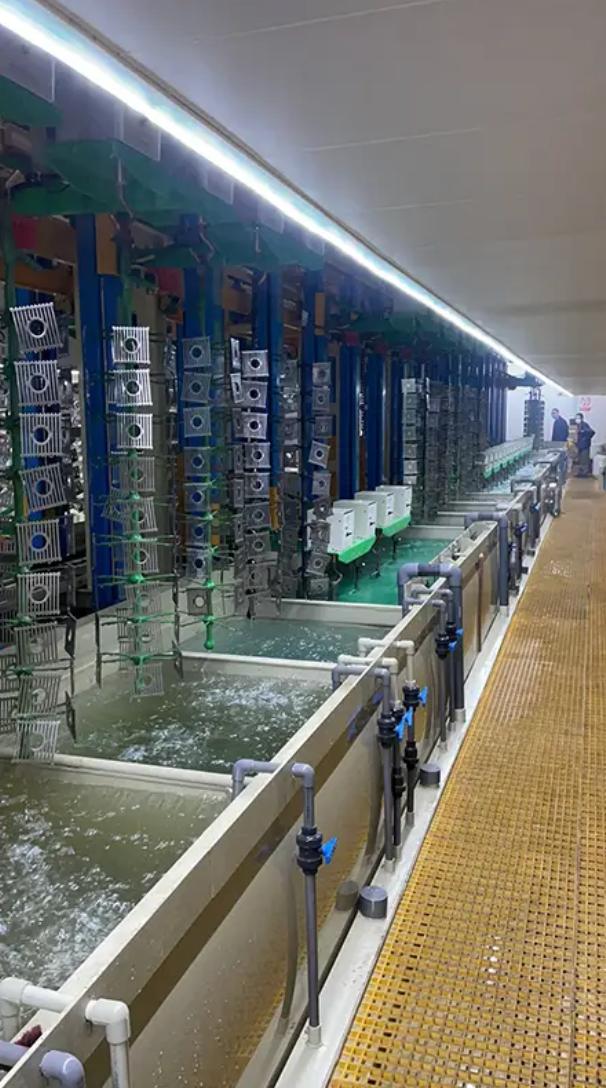
Custom racks do more than hold parts—they dictate how coating settles on every surface. We design each rack around your part geometry, adding or reducing contact points so current flows evenly and the coating builds at the same rate across the entire load. That means no more thick edges, thin centers, or wasted powder on areas nobody sees.
The real trick is in the details: spring-loaded contacts that maintain pressure through the oven cycle, masked zones that keep critical threads clean, and frame layouts that let the coating wrap naturally instead of pooling. When a rack locks in your target thickness, your line runs faster because you stop compensating with extra coats or manual touch-ups.
It also makes your process repeatable. Once the rack geometry is dialed in for a part number, every batch comes out within your tolerance window, regardless of who's hanging the line. That consistency eliminates guesswork and lets your team focus on output rather than rework.
Faster Cycle Times with Staged Vertical Transfer
Staged vertical transfer splits a full-height move into several short, independently controlled lift segments. Instead of one elevator carrying a carrier from floor to mezzanine and back, each segment serves a dedicated zone with its own buffer position. A part only needs to travel one level at a time, so the next station can pull it almost immediately after the previous step finishes.
The cycle-time advantage comes from overlapping waiting periods. While a tray moves up one segment, the segment below is already receiving the next tray, and the segment above is handing off to the line. This keeps the vertical path continuously loaded, so no station sits idle waiting for a long elevator stroke to complete. Short, repeatable movements also reduce positioning error and allow faster acceleration profiles without overshoot.
On an SMT line, for example, staged lifts between screen printer, placement machines, and reflow ovens can hold one board per stage. The placement machine takes a board from its nearest lift stage rather than waiting for a central return conveyor. That trims seconds from each board transfer, which compounds into a noticeably faster line cycle when running high-mix batches.
Closed-Loop Rinsing Keeps Bath Chemistry Stable
In conventional open rinsing, drag-out from the process bath steadily leaches metal salts, brighteners, and other additives into the rinse water, forcing operators to chase drifting concentrations with frequent lab checks and corrective additions. Closed-loop rinsing changes that dynamic. By routing rinse effluent through a recovery unit—whether ion exchange, reverse osmosis, or evaporation—the captured chemistry is returned to the working tank rather than discharged. This creates a near-steady-state condition where the bath’s active ingredients remain within a narrow band, reducing the need for constant titration and manual dosing.
A common setup uses a multi-stage counterflow rinse followed by a concentrator. The first rinse stage, richest in drag-out, feeds back to the process tank either directly or after passing through a filter to remove particulates. Conductivity sensors in the recovery loop monitor salt load and trigger make-up water only when the concentration drops below a set threshold. This feedback control prevents the sudden dilution spikes that occur when operators manually top up rinse tanks and accidentally send large volumes of low-conductivity water back into the bath.
The result is more than just lower chemical consumption. Stable bath chemistry translates to consistent plating thickness, uniform alloy composition, and fewer rejects from roughness or dullness caused by additive imbalance. It also minimizes sludge formation and reduces the frequency of bath dumps, since degradation products are either filtered out or kept below tolerance limits by the continuous recovery process. For high-volume lines, the payback comes quickly through reduced waste treatment costs and less downtime for bath correction.
Single-Pass Plating Reduces Rework on Complex Shapes
Complex geometries, such as deep recesses, sharp corners, and threaded holes, tend to plate unevenly when the part has to go through multiple passes. Each pass introduces a new chance for thickness variation, voids, or edge buildup. Shops often compensate with extra grinding or spot plating, which eats into lead time. A single-pass approach removes that iterative loop entirely, depositing the full required layer in one controlled cycle.
The real benefit shows up on parts that mix tall features with tight internal radii. Instead of masking areas to prevent over-plating or running a second touch-up pass, the single-pass process uses adjusted current density and bath flow to hold tolerance across the whole surface at once. Rework drops because there is no thin spot left behind from an earlier pass and no ridge line where two layers meet.
For a production cell, that means fewer inspection hold points and less handling. Operators aren't constantly sorting marginal parts or re-racking rejects. The plating line's throughput climbs, and the cost per conforming part falls, not because the chemistry got cheaper, but because the rework loop that used to sit between pass one and pass two stopped existing.
Line Layouts Built Around Sanitary Ware Geometry
Plumbing runs in bathrooms and washrooms often fight for the same cramped wall cavities and floor chases. When pipes are laid without considering the exact footprint of a toilet, basin, or urinal, the result is a tangle of elbows and offsets that eats space and drives up labor. Starting from the sanitary ware geometry flips that order. The rough-in points, spud locations, and trap arm directions become the primary constraints, not afterthoughts. A wall-hung toilet with a concealed carrier, for instance, pushes the waste line behind the finished surface at a specific height and depth. If that geometry is mapped first, the vent and supply lines can run parallel or perpendicular in predictable layers instead of weaving around unexpected projections.
The benefit shows up quickly in tight renovations or multistory stacks. Rather than using standard 90-degree bends everywhere, a layout tuned to the exact bowl depth and rim height can employ long-turn wyes or 45-degree offsets only where the geometry demands them. This reduces turbulent flow at junctions and keeps the horizontal runs within code-required slopes without resorting to deep furring. For a row of identical lavatories, measuring the center-to-center spacing of the basins and aligning the trap arms with the drain outlet on each fixture creates a repetitive, almost modular pipe grid. Any deviation from that baseline becomes visible immediately, so mistakes get caught before the wallboard goes up.
Beyond saving space, this approach changes how installers sequence their work. The plumber can set the carrier frames or floor flanges first, then build the drainage and venting outward from those fixed points. Supply piping follows the same reference planes, keeping hot and cold lines clear of trap seals and cleanouts. When the geometry of the sanitary ware drives the layout, the final assembly looks less like an improvised puzzle and more like a deliberate system. Maintenance access improves as well, because shutoffs and cleanout plugs land in predictable, unobstructed zones rather than behind the deepest curve of a pedestal or inside a vanity toe-kick.
FAQ
Vertical lift systems let parts hang freely, so plating solution drains more evenly and pockets or trapped air are less likely to cause skips. For shapes like faucet bodies, shower heads, and drain fittings, that often translates into a more consistent finish and fewer rework cycles.
By matching tank dimensions, hoist speed, and rectifier output to the exact part geometry and target thickness, custom equipment eliminates wasted movement and overplating. Many facilities see shorter cycle times and lower chemical consumption per piece without pushing the line beyond its design limits.
Yes, if the tooling and flight bars are planned for it. Custom vertical lift lines often include adjustable racks or quick-change carriers, allowing faucet bodies, escutcheons, and small accessories to run in the same bath with dedicated current zones.
The main gains are more uniform thickness distribution, better adhesion in recessed areas, and reduced edge buildup. Because parts are positioned vertically, drainage is faster between stations, which also lowers the chance of cross-contamination and staining.
They are critical. A properly designed vertical lift system pairs the lifting motion with eductor or air agitation and staged filtration. That keeps the bath homogeneous and removes particulates, so coating defects like roughness or pitting stay under control.
Look at the load envelope, cycle time simulation, access for maintenance, and whether the controls can store recipes for different part families. Also ask about exhaust and containment, since sanitary ware plating often involves bright nickel and chrome steps that require careful ventilation.
In most cases, yes. Once parts are racked, the hoist sequence moves them through cleaning, plating, rinsing, and drying stations automatically. Operators spend less time lifting and shifting heavy racks, which improves both safety and throughput consistency.
They can be, particularly when the line is built around a compact footprint and modular tank sections. A smaller custom system may still deliver the same vertical-drainage benefits without requiring the floor space of a full-scale automated plant.
Conclusion
Vertical lift plating changes the game for sanitary ware because traditional horizontal lines struggle with the deep recesses and hidden contours common in toilet bowls, basins, and traps. By suspending workpieces vertically and moving them through the bath sequence, solution reaches every internal surface without trapped air pockets. Custom racks are designed to hold each ceramic or metal form at the precise angle that locks in uniform coating thickness, so the nickel-chrome layer stays consistent even around rim outlets and overflow channels. The staged vertical transfer between tanks shortens dwell time because parts drain faster between process steps, and the lift schedule can be tuned to match part geometry.
Closed-loop rinsing further stabilizes bath chemistry by returning drag-out solution to the plating tanks after filtration, which reduces additive drift and keeps the deposit bright. With single-pass plating, complex shapes no longer need repeated dips or touch-up work; the vertical orientation lets the current distribution follow the part profile in one continuous pass. Line layouts built around sanitary ware geometry place the most aggressive cleaning and activation stations closer to the plating cells, cutting non-value movement. The result is a faster, more consistent coating that resists corrosion and wear in high-use bathroom environments, while lowering rework rates and chemical consumption.
Contact Us
Contact Person: hayyr
Email: [email protected]
Tel/WhatsApp: 8613082110525
Website: https://www.jundaelectroplating.com