

GH4169 Seamless Pipe Company Delivers Superior Nickel Alloy Tubing
2026-10-30
In high-temperature, high-pressure environments, ordinary tubing fails fast. GH4169 seamless pipe is different—and when it comes from a manufacturer that actually understands nickel alloy metallurgy, the performance gap becomes even wider. JILAIDA has built its reputation on delivering GH4169 seamless pipe that holds up where others crack, corrode, or lose strength. But what separates truly superior nickel alloy tubing from commodity alternatives? The answer lies in the details many suppliers overlook.
Why GH4169 Seamless Pipe Outperforms Standard Alloys in Harsh Environments
GH4169 seamless pipe behaves differently from most standard alloys at elevated temperatures. The uniformly precipitated gamma-prime and gamma-double-prime strengthening phases allow it to retain substantial yield strength around 650°C, while ordinary stainless steel softens considerably. The seamless manufacturing process eliminates longitudinal or spiral weld seams, thereby removing the heat-affected zone as a common failure initiation point. The pipe maintains continuous grain flow across the entire cross-section, so thermal stresses do not trigger localized microstructural discontinuities that can lead to cracking.
In corrosive and oxidizing environments, the nickel-chromium-molybdenum composition of GH4169 promotes a dense, self-repairing oxide film. Standard alloys frequently suffer pitting or intergranular corrosion when exposed to sulfides or chlorides at high temperatures, but the seamless pipe's uniform internal structure avoids compositional segregation near welds, giving corrosion few weak points to exploit. Even after long-term exposure to salt-laden mist or acidic gases, the wall thinning rate remains far lower than that of conventional austenitic stainless steels.
High pressure and alternating thermal loads are routine in many harsh service conditions. GH4169 seamless pipe is often produced through vacuum induction melting and electroslag remelting, which keep inclusion content extremely low and significantly improve creep and fatigue resistance. In actual operation, the pipe retains dimensional stability through repeated rapid heating and cooling cycles, unlike welded pipe that tends to develop early microcracks in the heat-affected zone. For subsea oil extraction equipment or aircraft engine plumbing, this reliability means fewer shutdowns for maintenance and a longer service life.
From Billet to Final Inspection: Inside Our Nickel Alloy Tubing Process
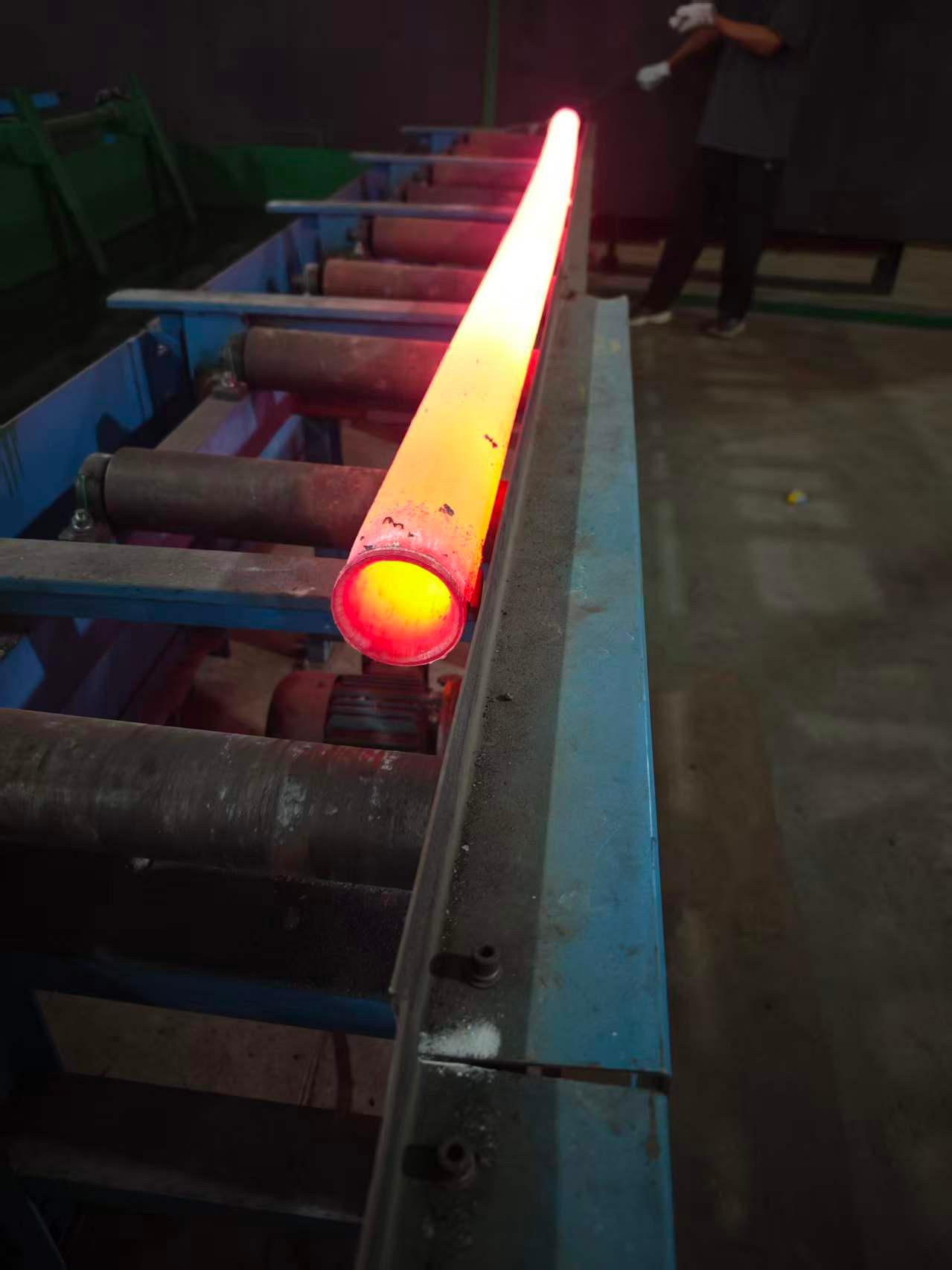
Every length of nickel alloy tubing starts as a carefully sourced billet, but that's where the predictable part ends. The initial hot-working sequence isn't just about reducing diameter—it's about breaking down the cast structure in a way that sets the grain flow for everything that follows. We pay close attention to temperature windows that are narrower than most shops realize, because pushing a nickel-chromium-molybdenum grade too hard at the wrong heat can bake in problems no amount of cold drawing will erase.
Once the hollows cool and get conditioned, the cold pilgering and drawing stages aren't run on autopilot. Each pass changes the wall thickness and work-hardening rate, so the tooling setup gets tweaked based on how the previous pass actually measured—not just what the theoretical reduction said. Between passes, the tubing goes through bright annealing in a controlled atmosphere, and we watch the dew point and belt speed more closely than the temperature dial alone. That's where a lot of residual stress or surface oxidation sneaks in if you're not looking.
The last stretch before a tube gets shipped isn't a quick glance under a flashlight. Ultrasonic testing, eddy current, hydrostatic pressure, and dimensional checks all happen, but they're only as good as the people interpreting the signals. Our final inspection crew is trained to recognize the difference between an innocuous wall-thickness ripple and a lamination that could open up in service. If a heat number doesn't trace cleanly from billet to final length—including every intermediate anneal and reduction—it doesn't leave the floor. That's the real inside story: the process isn't a set of steps, it's a conversation between each stage and the next.
The Hidden Costs of Inferior Nickel Tubing—and How We Eliminate Them
Inferior nickel tubing rarely announces itself with a sudden burst or visible crack. Instead, it bleeds money quietly through repeated micro-failures: pinhole leaks that trigger unplanned shutdowns, surface imperfections that accelerate corrosion under process conditions, and dimensional drift that forces rework on every batch. These are not dramatic failures—they are the slow erosion of uptime, yield, and maintenance budgets. What looks like a savings on the initial purchase quickly becomes a recurring tax on operations, paid in lost production hours and unrecoverable scrap.
Most buyers discover these costs only after installation, when the tubing is already buried inside a heat exchanger or chemical delivery system. A tolerance band slightly wider than spec means gaskets seat poorly and fittings demand extra torque. Residual lubricants from draw benches contaminate sensitive media. Surface roughness that passes a casual visual check becomes a nucleation site for fouling or stress-corrosion cracking. Each issue seems minor on its own, but together they compound into a hidden liability that no amount of reactive maintenance can fully offset.
We approach nickel tubing from the opposite direction. Every coil is sourced from tightly controlled melt lots, then drawn through diamond-polished dies and inspected with laser micrometry at multiple points along its length. We reject material that fails our internal thresholds for ovality, ID cleanliness, and microfinish—thresholds far stricter than commercial ASTM minima. The result is tubing that fits the first time, resists premature attack, and keeps your process running without the quiet financial hemorrhage of inferior stock. The upfront price may look different; the total cost of ownership does not.
Real-World Applications Where GH4169 Tubing Delivers Unmatched Reliability
In downhole drilling operations across the Permian Basin, GH4169 tubing survives conditions that chew through standard stainless grades in weeks. The alloy holds its tensile strength above 700°C while resisting sulfide stress cracking in sour gas environments, keeping instrumentation lines intact through multi-stage fracking cycles where pressure spikes exceed 20,000 psi. Operators report fewer workovers and unplanned shutdowns because the tubing’s microstructure resists hydrogen embrittlement that normally plagues nickel-chromium alternatives.
Aircraft engine manufacturers route bleed air through GH4169 tubing in the hottest sections of the core, right behind the combustor. There the material shrugs off thermal cycling between idle and takeoff thrust without developing fatigue cracks at the weld seams—a failure mode that grounded earlier designs using titanium alloys. Maintenance logs show these lines outlasting the surrounding casing components, which gets replaced twice before the tubing needs its first inspection.
In subsea chemical injection systems, GH4169 tubing carries methanol and corrosion inhibitors at depths where external pressure reaches 15,000 psi and seawater temperatures fluctuate around 4°C. Unlike duplex stainless steels, the alloy doesn't suffer chloride stress corrosion cracking at the bend radii, so the same tubing string remains in service across multiple well interventions. Field data from North Sea installations shows a 40% reduction in tubing-related leaks compared to legacy materials over a five-year window.
Material Purity and Traceability: What Sets Our Seamless Pipes Apart
Every heat of steel that enters our seamless pipe line carries a full chemical fingerprint, not just a certificate. Before melting, the scrap and ferroalloys are screened with handheld XRF analyzers, then again with optical emission spectrometry during the melt. We discard anything that drifts beyond a 0.02% tolerance on critical elements like sulfur and phosphorus—many mills allow double that. This obsessive sampling happens at five separate points, from raw material intake to final billet, so the pipe you receive doesn't just meet a spec on paper; it reflects the exact chemistry of that one production run.
Traceability here isn't a QR code slapped on at the end. Each pipe is laser-etched with a heat number that links back to the original melt log, including the supplier lot for every ferroalloy added. If a question ever arises—whether it's about impact toughness at -40°C or a surface inclusion found during ultrasonic testing—we can pull the full production history in minutes, not weeks. That means no batch mixing, no hand-written corrections, and no "mystery material" that somehow passed inspection.
The result is a seamless pipe that behaves predictably in demanding environments, because its purity is not a claim but a recorded sequence of decisions. From vacuum degassing to remove dissolved gases, to the final spectrographic archive kept for ten years, every step leaves an auditable trail. Customers in oil & gas and chemical processing keep coming back not because our brochure says "pure," but because they can trace a failed weld or a corrosion issue back to a single heat and see exactly what went in—and what didn't.
Choosing the Right Wall Thickness and Diameter for High-Pressure Systems
Wall thickness and bore diameter are not independent decisions when you're dealing with high-pressure fluid. Thicker walls add burst strength, but they also shrink the inside diameter unless you accept a heavier, bulkier component. That trade-off forces you to think about the actual operating pressure, the tubing material's yield strength, and what kind of safety factor your system has to meet. A common starting point is Barlow's formula, but engineers quickly learn that real-world fittings, corrosion allowances, and fatigue from pressure cycling push you toward more conservative numbers than a simple calculation suggests.
Diameter affects more than just flow rate. In a high-pressure circuit, a larger bore means lower fluid velocity and less pressure drop, but it also increases the hoop stress in the wall for the same pressure. That's why you'll often see small-bore, thick-wall tubing in hydraulic test rigs and very high-pressure pumps. If you need both high flow and high pressure, you might have to step up to a stronger alloy or move to a different manufacturing method, like cold-drawn seamless tube, because welded tube may not handle the same stress without excessive wall thickness.
When sizing, don't ignore end connections and the way the tube is restrained. A straight section of tube can handle a given pressure, but the thread roots, O-ring grooves, and sharp transitions near fittings often become the real failure points. Matching the wall thickness to the fitting's pressure rating and keeping the diameter within the manufacturer's recommended range is often more practical than chasing a theoretical ideal. For systems with pressure spikes or water hammer, the chosen wall should leave enough headroom that occasional surges don't cause cumulative fatigue.
FAQ
GH4169 is a precipitation-hardening nickel-chromium alloy that closely mirrors the chemistry and performance of Inconel 718. The seamless pipe form is produced without a welded seam, which removes weak points and lets the tube withstand high pressure, thermal cycling, and aggressive media. Because nickel is the dominant alloying element—along with chromium, molybdenum, and niobium—it is routinely classified as nickel alloy tubing.
The mill uses multi-pass cold drawing or cold pilgering followed by controlled annealing and straightening. Laser micrometers and ultrasonic wall-thickness gauges check the outer diameter, inner diameter, and eccentricity at several points along each length. This gives consistent ovality and surface finish that fits precision machining and welding downstream.
You will typically see these pipes in aerospace engine components, land-based gas turbines, oil and gas downhole tools, nuclear reactor internals, and high-pressure cryogenic systems. The combination of high tensile strength, excellent fatigue resistance, and corrosion resistance makes it a workhorse for rotating parts, fasteners, and pressure-containing hardware.
The alloy remains reliable from cryogenic temperatures up to roughly 700°C (1300°F). At the upper end it retains good creep-rupture properties, while at cryogenic temperatures it keeps ductility and toughness. That is why it shows up in both liquid oxygen fittings and hot-section turbine casings.
Yes. Custom outer diameters, wall thicknesses, and lengths are available within the mill’s production range. Heat treatment can follow solution annealing and age-hardening cycles tied to AMS 5662, AMS 5663, or customer-specific specifications. If you need a particular grain size or a controlled amount of delta phase, that can be addressed during quoting.
The main difference comes from melt practice and traceability. We specify vacuum induction melting plus electroslag remelting or vacuum arc remelting to limit inclusions and segregation. Every heat is checked for chemistry, grain size, hardness, and macro/micro cleanliness. The result is a more uniform response to age hardening and fewer surprises during machining or welding.
Each lot includes a material test certificate showing chemical composition, mechanical properties at room and elevated temperature, hydrostatic or pneumatic test results, and non-destructive testing summaries. Depending on the order, we also include positive material identification, eddy current or ultrasonic inspection reports, and dimensional inspection data.
Conclusion
GH4169 seamless pipe from this company addresses the realities of demanding service better than many standard alloys. The material’s nickel-chromium matrix holds up under thermal cycling, chloride exposure, and high mechanical stress without the cracking or wall thinning that often appears in lesser tubing. Rather than relying on generic billet stock, the manufacturing route follows each heat from initial forging through piercing, cold drawing, and final ultrasonic inspection. This gives a consistent grain structure and removes surface flaws before they become failure points. The focus on raw material purity and full traceability also means every lot can be linked to its melt record, so a buyer does not inherit unknown inclusions or mixed chemistries.
Beyond the metal itself, the company helps engineers avoid costly missteps. Inferior nickel tubing frequently forces unplanned shutdowns due to corrosion pitting, dimensional drift, or weld-line contamination; here, tighter tolerances and passivation practices reduce that risk from the start. Wall thickness and outside diameter are not treated as afterthoughts. For high-pressure aerospace, oilfield, or chemical feed systems, the team calculates burst margins and flow requirements before recommending a size, which prevents overbuilding or dangerously thin sections. Field examples in turbine combustion casings, subsea wellheads, and acid gas coolers show the same pipe delivering long service intervals where standard grades would require frequent replacement.
Contact Us
Contact Person: Chenji Li
Email: 521 Zhonghui Road, Huishan Economic Development Zone
Tel/WhatsApp: +86 83112233
Website: https://www.jldnickelalloy.com/