

Stainless Steel Hex Self Drilling Screws Company: How to Pick the Best Manufacturer for Your Projects
2026-10-04
When your project depends on stainless steel hex self-drilling screws, the manufacturer you choose is just as important as the fastener itself. All too often, buyers discover inconsistencies in thread quality, drilling performance, or corrosion resistance only after installation—turning a small component into a costly headache. That's why Wanluo has made precision manufacturing and strict material verification the foundation of every batch. In this article, we'll break down the essential criteria for identifying a reliable supplier, so you can avoid the common pitfalls and build with confidence.
What Your Project Actually Demands From the Fastener
The term 'fastener' often gets reduced to a parts-list afterthought, yet the real demand from your project has little to do with a catalog number. It starts with a precise inventory of what the joint must survive: repetitive vibration from a motor mount, thermal cycling on an exhaust flange, or a one-time shock load during equipment installation. Each of these scenarios shapes a different set of requirements for thread engagement, preload retention, and fatigue resistance. Without naming the actual stress paths, you end up specifying a bolt that fits the hole but not the duty cycle.
Beyond mechanics, the project also demands compatibility with the surrounding materials and the assembly sequence. A stainless fastener in an aluminum housing invites galvanic corrosion unless isolation is planned, while a high-strength steel screw can crack a brittle plastic boss if the pilot hole and torque are not tuned together. The fastener choice influences how serviceable the assembly becomes months later, whether that means reusing a panel screw without stripping threads or replacing a shear pin without damaging a shaft. These practical constraints rarely appear in a generic strength table, but they dominate real-world performance.
A useful approach is to treat the fastener as a miniature structural component with its own installation window, not as a commodity to be swapped at the last minute. Write down the reversible and irreversible forces, the operating temperature swing, the presence of moisture or chemicals, and the expected number of assembly cycles. Then test the chosen fastener under those combined conditions instead of relying on a single axial load rating. The project seldom cares about ultimate tensile strength in isolation; it cares how the joint behaves after a thousand thermal cycles or a year of road vibration. Fastener selection becomes a design decision rather than a procurement step when you listen to what the assembly actually says it needs.
Reading the Steel Grade Like a Metallurgist, Not a Marketer
Most people glance at a steel grade and see a brand promise: “high strength,” “wear resistant,” “premium.” A metallurgist sees a formula. Take 1045 versus 4140. The 10 means plain carbon, the 45 means about 0.45% carbon. That tells you hardness potential but also warns about weldability and toughness limits. The 41 in 4140 signals chromium-molybdenum alloying, which shifts hardenability and high-temperature strength. Reading the grade this way turns vague sales language into predictable performance boundaries.
The real skill is matching those numbers to the failure mode you're trying to avoid. A part that cracks in service might not need a “stronger” steel; it might need a grade with lower carbon and higher nickel for toughness at low temperatures. Marketers often push tensile strength as the headline number, but a metallurgist checks the whole curve—yield, elongation, reduction of area—and the heat treatment state. As-quenched 4140 behaves very differently from normalized 4140, even though the grade name never changes.
Finally, trust but verify. A mill certificate is not a performance guarantee. A metallurgist reads the grade as a specification range, not a fixed identity. Two heats of A36 can differ in carbon and manganese within allowed limits, and that affects actual behavior. When a datasheet says “equivalent to” some other grade, treat it as a hint, not a fact. The only way to read steel like a metallurgist is to connect the designation to a specific chemical composition, a defined heat treatment, and a tested mechanical property—then ask what’s missing.
Where Heat Treatment and Thread Geometry Show Their Hand
Heat treatment doesn't just harden a fastener—it rewrites its failure story. When a thread is cut or rolled, the grain flow near the root changes direction, and a poorly chosen temper can leave those valleys brittle under cyclic load. What shows up in the field as a snapped bolt often traces back to a missed quench step or a soak time that drifted into the danger zone.
Thread geometry then decides where that weakness announces itself. A shallow root radius acts like a stress concentrator, and no amount of case depth can fully hide it. Conversely, a well-executed rolled thread after proper austenitizing creates a compressed surface layer that resists crack initiation. The hand of both processes is visible under a microscope: decarburization near crests, uneven martensite distribution, or a white layer from grinding too hot.
The real craft is matching the heat cycle to the thread's final form. A high-strength bolt with sharp V-threads and a deep hardening treatment may look impressive on paper, but it can fail earlier than a softer, more ductile fastener with generous radii. In design reviews, the question isn't just “was it heat treated?” but “did the treatment respect the thread geometry?” When those two variables align, the failure mode shifts from sudden snap to graceful yield—and that's where longevity quietly lives.
Batch Testing That You Can Verify Independently
Running batch tests shouldn't mean surrendering your ability to check the results yourself. Whether you're validating a set of numerical outputs, parsing structured data, or comparing generated text against a known reference, the goal is to design a process where each batch can be inspected without needing to trust a black box. Start by splitting the batch into smaller, manageable chunks—each with its own input, expected outcome, and a clear pass/fail condition. This way, you’re not just waiting for a final summary; you can open any individual result and trace it back to its source.
One practical approach is to log every step of the batch run in a human-readable format, such as a plain text file or a CSV export. Include the original input, the actual output, and the expected output side by side. If something looks off, you can isolate that single case and run it again manually, without redoing the entire batch. This also helps when you need to share results with someone else—they can verify the same data independently, rather than relying on a summary report that might hide edge cases.
For more complex pipelines, consider using a simple checksum or hash for each batch input and output. It doesn't need to be cryptographic; a straightforward checksum lets you confirm that the data hasn't been altered or truncated during processing. Combined with random sampling—where you pick a few items from the batch and verify them by hand—this gives you a strong level of confidence without the overhead of checking every single row. The key is to build verification into the workflow from the start, so that independent review feels natural, not like an afterthought.
Minimums, Lead Times, and the Costs Nobody Quotes Up Front
You'll spot the per-unit price first—usually because it's the only number printed large. What's not there is the minimum order quantity, often buried in a footnote or only revealed when you ask for a quote. A factory might list $2.40 per piece, but that price requires 5,000 units. If you only need 300, the actual cost per unit jumps once setup, tooling, and line changeover get amortized across a smaller run.
Lead times follow the same pattern. A supplier may promise "2–3 weeks" on a call, then add a week for material sourcing, three days for packaging approval, and another stretch for QC after production. That's before freight. When the shipment arrives, you discover palletization fees, customs brokerage, port handling, and inland trucking were never part of the conversation—yet they're on your invoice.
The real cost nobody quotes up front is the cost of your own calendar. Every unplanned delay ripples through inventory planning, launch dates, and cash flow. If you're comparing suppliers, ask for the full landed cost at your actual order size, and get lead time commitments in writing with penalties for slippage. That's the only way to make the numbers honest.
Support After the Shipment Is the Real Contract
A signed order might get the product onto the truck, but it says nothing about the calls you'll take at month six, the spare parts that arrive before the line stops, or the engineer who remembers your machine's quirks by name. That ongoing presence—often invisible until something breaks—is where suppliers either earn their margin or quietly lose your trust. Promises made in a polished sales deck fade fast when a warehouse in another time zone goes quiet.
Real support doesn't live in a warranty clause. It shows up as a direct line to someone who can authorize a replacement without three levels of approval, as firmware updates that arrive before you notice the bug, as a technician who trains your team on a Tuesday afternoon instead of pointing to a PDF. These moments rarely appear in procurement scorecards, yet they decide whether a machine keeps running or becomes a very expensive paperweight.
The suppliers that last understand this: the shipment is just the opening move. What follows—the diagnosis at 2 a.m., the honest answer when a batch is defective, the willingness to say "we'll fix it" instead of "read the manual"—is the actual contract. It's unwritten, unreviewed by legal, and far more binding than anything signed at a trade show.
FAQ
Focus on material traceability, consistent thread geometry, and whether they can provide test reports for corrosion resistance. A good supplier won't just claim "stainless" — they'll show you the grade and batch details.
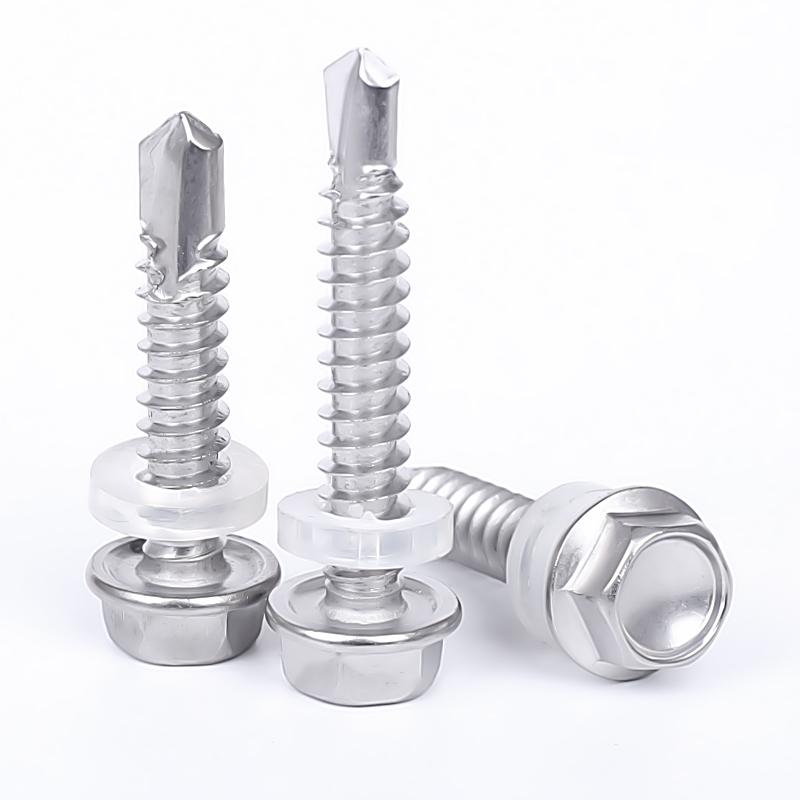
Ask for samples and run them on your actual material stack-up. Check the drill point for clean cutting without walking, and inspect the hex head for proper socket engagement. Also request salt spray test results if the application is outdoor or marine.
304 and 410 have different strength and corrosion profiles. 410 is harder and often used for self drilling into metal, while 304 offers better rust resistance but may need a sharper point or pilot hole. The manufacturer should guide you based on the substrate, not just sell you a generic "stainless" screw.
Vague answers about raw material origin, refusal to provide mill certificates, or inconsistent lead times. Also be wary of prices that are significantly lower than the market average — that often means recycled stainless or skipped heat treatment.
In-house testing gives faster feedback, but third-party certification adds credibility. The best approach is a manufacturer that does both: routine in-house checks for dimensions and hardness, plus periodic third-party validation for corrosion and mechanical properties.
Very important. Self drilling screws require precise drill point geometry and heat treatment to avoid snapping or failing to penetrate. A company that mainly makes wood screws may not have the right equipment or know-how for hardened stainless hex drilling screws.
Yes, and this is often a sign of a capable supplier. They should be able to adjust thread pitch, point style (e.g., #2, #3, #4), and even head markings. If they only offer off-the-shelf sizes, you may be limited in optimizing your project.
Reliable manufacturers typically have clear MOQs based on diameter and length, and they can give realistic lead times that account for raw material procurement. If they promise extremely short lead times on stainless, ask where the stock is coming from—it might be sitting in a warehouse without proper traceability.
Conclusion
Most purchasing mistakes start before a single quote is requested. You have to know what the screw is actually being asked to do—pull-out resistance in thin gauge sheet, corrosion exposure near saltwater, or repeated thermal cycling on a rooftop. That demand profile should dictate the steel grade, not the other way around. A true manufacturer will talk about 410 versus 304 or 316 in terms of hardness, work-hardening behavior, and chloride limits, not just “marine grade” labels. Then look at how the screw is made: heat treatment changes whether the drill point survives first contact with thicker steel, and thread geometry—pitch, flank angle, under-head fillet—determines whether the fastener seats consistently or strips under torque. If the company’s technical staff can’t explain those links without reaching for a brochure, walk away.
The second filter is proof, not promises. Ask for batch test reports from an independent lab, and verify a few yourself against the actual lot numbers—charm disappears fast when tensile or salt-spray results don’t match. Equally telling are the commercial terms nobody volunteers: minimum order quantities, real lead times when a container is delayed, and the hidden costs of customs, packaging, or split shipments. A manufacturer that quotes only ex-works price and “four to six weeks” hasn’t earned trust. Finally, judge them by support after the pallet arrives. Do they help with torque settings, installation failures, or field complaints, or do they go silent once the invoice is paid? The best stainless hex self-drilling screw partner may not be the cheapest, but they are the one whose engineering and logistics answers match your job-site reality.
Contact Us
Contact Person: Shane
Email: [email protected]
Tel/WhatsApp: 8613357785029
Website: https://www.wanluohardware.com