

Top 10 Boron Carbide Applications You Need to Know
2026-09-16
Boron carbide rarely makes headlines, yet it silently outperforms most materials you already know. With a hardness just below diamond and a density lighter than steel, this ceramic has moved far beyond military armor. In the following list, we explore ten applications of boron carbide that range from nuclear shielding to precision nozzles—each one reshaping industries in unexpected ways. At HUAYI TECH, we have watched demand shift from traditional defense contracts to consumer tech and clean energy. If you think boron carbide is just a bulletproof material, these examples will prove you wrong and maybe spark your next big idea.
Ballistic Armor: Ceramic Plates That Defeat Armor-Piercing Threats
A hardened steel core or tungsten penetrator moving at rifle velocities concentrates enormous energy into a tiny point. Ceramic plates counter this not by absorbing the hit like soft armor, but by shattering the threat. When the tip strikes the tile, the ceramic's extreme surface hardness blunts and fractures the projectile, spreading the force across a much wider area before the backing layer catches what remains.
Not all ceramics are equal. Boron carbide offers the lowest weight but costs more and can be brittle under repeated drops. Silicon carbide strikes a balance between weight and durability, while alumina is heavier and cheaper. Behind the strike face, a composite backing—usually ultra-high-molecular-weight polyethylene or aramid—deforms to catch fragments and prevent blunt trauma.
Real-world performance depends on the entire system, not just the tile. Multi-curve profiles reduce standoff and improve comfort, but edge impacts and close-range hits remain difficult. Proper storage away from moisture and long-term temperature swings matters because ceramic can lose strength after repeated hard drops, even when no crack is visible.
Neutron Absorbers in Nuclear Control Rods and Shielding
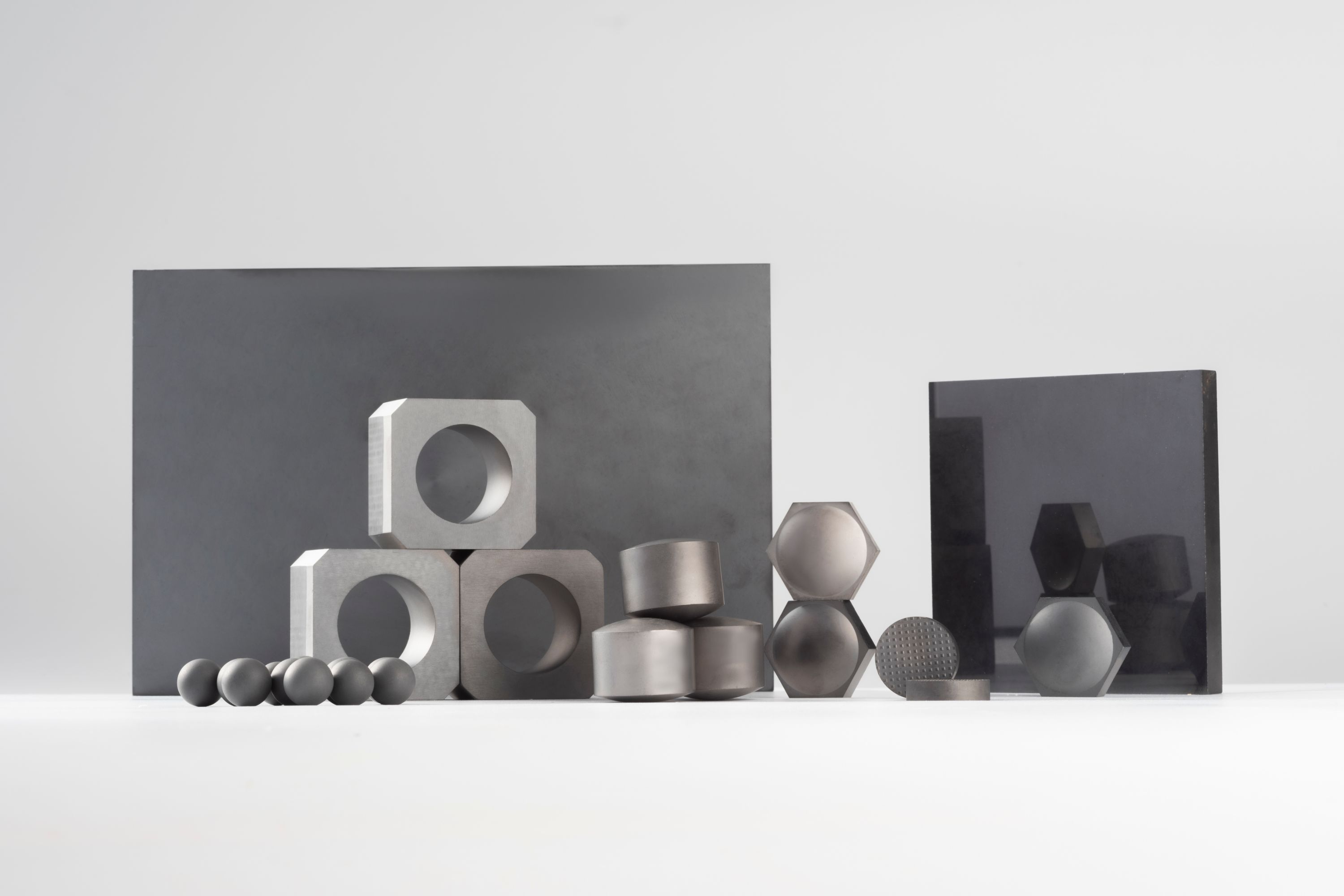
Control rods rely on materials with a high affinity for capturing thermal neutrons, a property measured by the neutron absorption cross section. Elements like boron, cadmium, hafnium, and gadolinium are commonly used, each offering distinct advantages depending on reactor design. Boron, often in the form of boron carbide or borated steel, is valued for its broad energy absorption range and resistance to swelling under irradiation. Cadmium, while effective for thermal neutrons, has a lower melting point that limits its use in high-temperature cores. Hafnium stands out because it forms a series of isotopes that remain strong absorbers even after multiple neutron captures, allowing longer fuel cycles without replacement. Gadolinium, frequently mixed directly into fuel pellets as a burnable poison, helps flatten the power distribution during early operation.
Shielding applications place different demands on neutron absorbers, prioritizing durability, cost, and ease of fabrication over nuclear performance alone. Concrete mixed with boron compounds, such as colemanite or boron frit, is a standard choice for biological shields around reactors and spent fuel pools. Water and polyethylene serve as effective moderators, slowing fast neutrons so that absorber materials like boron or lithium can capture them more efficiently. Lead, while an excellent gamma shield, does little to stop neutrons unless combined with a hydrogenous material or a dedicated absorber layer. In portable or compact shielding, lithium-6 enriched materials and high-density polyethylene loaded with boron are preferred for their light weight and high capture efficiency.
The selection of a neutron absorber hinges on more than just cross section. Engineers must weigh factors such as radiation stability, chemical compatibility with cladding and coolant, and the buildup of helium gas from (n, alpha) reactions, which can cause swelling or cracking over time. For control rods, the absorber must maintain mechanical integrity under severe temperature gradients and vibration. For shielding, long-term exposure to neutron flux can degrade organic polymers, so inorganic boron compounds or metal matrix composites are often substituted. Advances in material science continue to refine absorber alloys and ceramic forms, aiming to extend service life while reducing waste volume at the end of a reactor's operating cycle.
Sandblasting Nozzles That Hold Up Under Continuous Use
Most sandblasting nozzles start strong but go mushy after a few hours of steady blasting. The liners in continuous-use models are a different animal. A proper long-run nozzle uses a thick boron carbide or similar composite liner that sheds heat quickly and resists the groove wear that turns a focused stream into a weak fan. Instead of swapping tips twice a shift, you get a consistent blast pattern from morning to break.
What separates the ones that actually hold up from the ones that just look tough on a spec sheet is how the liner is seated and how the jacket dissipates heat. Cheaper nozzles let abrasive creep behind the liner, causing premature blowouts right at the threads. Well-built continuous-duty nozzles use a compression fit or a bonded liner that keeps the abrasive exactly where it belongs. The outer jacket might be aluminum or polyurethane, but it has to move heat away fast enough to keep the liner from cracking under thermal shock.
If you are running a nozzle eight hours a day, pay attention to the bore shape as much as the material. A slight taper or a venturi design reduces internal turbulence, so the abrasive does not eat the nozzle from the inside out. It is a small detail, but on a long production run it means the difference between a nozzle that still cuts cleanly at hour six and one that is sputtering by lunch.
Precision Lapping and Grinding Powders for Hardened Steel
Hardened steel surfaces rarely respond well to generic abrasives. The real work happens with a carefully matched powder, where friability, particle shape, and size distribution all matter more than the abrasive type alone. For lapping, you want a powder that breaks down at the right rate—sharp enough to cut, but not so aggressive that it gouges the surface or loads the plate. Diamond and CBN dominate for steels above 60 HRC, but the binder and coating chosen for the powder can shift results dramatically.
Grinding powders for hardened steel tend to favor a tighter particle spread. A narrow distribution keeps scratch depth consistent, which is critical when you are chasing flatness or a mirror finish before polishing. Many shops overlook the way slurry temperature and carrier fluid viscosity alter the cut. A powder that works beautifully in a thin oil may stall in water-based systems, so the same grit number is not a guarantee across setups.
Powder selection is not just about micron size. Look at how the particles are graded—some mills report mean size while others emphasize the largest particles, and that gap shows up on the part. For hardened tool steels and dies, testing a small batch against your current lap plate or wheel is the fastest way to see whether a new powder actually improves cycle time or just changes the scratch pattern.
Spent Fuel Casks and Reactor Shielding Layers
Spent fuel casks are engineered to confine both radiation and decay heat from used nuclear assemblies. Their walls typically combine a steel or iron gamma shield with a hydrogen-rich neutron absorber, often borated polyethylene or water, arranged in concentric layers. This geometry forces particles through multiple scattering events before escape, while the outer shell provides structural integrity during transport and storage.
Reactor shielding layers serve a similar dual purpose but operate under different constraints. Around the core, a heavy concrete biological shield attenuates fast neutrons and captures gamma rays, while a thermal shield of steel reduces neutron activation in pressure vessel walls. In pool-type reactors, several meters of water above the core act as a transparent but effective shield, also providing cooling and a medium for fuel handling.
The design drivers differ sharply: casks must survive hypothetical accident drops, fires, and submersion, so their shielding is often denser and more compartmentalized. Reactor shields, by contrast, are permanent structures optimized for continuous operation, where material selection balances cost, weight, and long-term radiation damage. Despite these differences, both systems rely on layered attenuation, with each layer chosen to address a specific part of the radiation spectrum.
Wear Parts for Slurry Pumps and Chutes
Slurry pumps and chutes face relentless abrasion from suspended solids. The wear parts that survive here aren't generic castings—they're selected for the specific particle size, slurry chemistry, and flow velocity. High-chrome white iron handles fine, hard particles well, while elastomers like natural rubber excel in wet, acidic environments with rounded solids. For severe gouging or large rock, manganese steel work hardens and extends service life. Matching the material to the wear mechanism keeps unplanned downtime low.
Beyond material choice, geometry matters. Thicker sections at impingement points, replaceable liners, and strategically placed sacrificial plates shift wear away from expensive structural components. In chutes, drop height and impact angle determine whether a ceramic tile, a rubber sheet, or a hardened plate is the right liner. A design that ignores these factors will simply wear out the wrong part first.
Inspection and rotation routines often reveal wear patterns before failure. Swapping symmetrical parts, monitoring thickness at high-wear zones, and keeping a small stock of critical liners prevents long outages. With slurry equipment, the wear part is a consumable, not a permanent fixture—planning for replacement is part of running the system efficiently.
FAQ
Its hardness sits just below diamond and cubic boron nitride, yet it is far lighter than steel. That combination lets soldiers and law enforcement officers wear protection that stops high-velocity rounds without adding excessive weight.
Boron-10, an isotope present in boron carbide, has a huge appetite for thermal neutrons. Control rods and shielding made from it keep fission reactions in check by absorbing excess neutrons before they can trigger further splitting.
Crushed into sharp, durable grit, it blasts through tough surfaces and cuts hard materials far longer than conventional abrasives, reducing downtime and replacement costs in industrial shops.
Yes. Composite panels with boron carbide tiles protect helicopters, patrol vehicles, and even aircraft cockpits. They deliver serious ballistic resistance while keeping overall weight low, which matters for fuel and agility.
It resists wear from abrasive slurries and high-speed particles, so nozzles made from it survive far longer in shot blasting, 3D printing, and chemical spraying than metal or polymer alternatives.
Surprisingly, yes. It sometimes appears in high-end watch cases, scratch-resistant phone parts, and specialty knife blades, where its hardness and dark gray sheen add both durability and a distinctive look.
It can be mixed into shielding containers or racks to absorb neutrons from spent fuel, reducing the risk of unintended criticality and making long-term storage safer.
Boron carbide is harder and often preferred for lapping very hard materials like tungsten carbide or ceramics. Silicon carbide is cheaper and sharper but wears faster, so the choice depends on whether longevity or cost matters more.
Conclusion
Boron carbide sits at the intersection of extreme hardness and low density, which explains why it has quietly become the go-to material for several life-or-death applications. Ballistic armor plates made from this ceramic stop armor-piercing rounds without weighing down the wearer—unlike steel, it defeats threats at a fraction of the mass. In nuclear facilities, the same material takes on a completely different role: its boron-10 isotope captures thermal neutrons so efficiently that control rods and spent fuel casks rely on it to keep chain reactions in check. Reactor shielding layers also benefit, cutting radiation exposure for workers while maintaining structural integrity. These two domains alone justify boron carbide's reputation, but they barely scratch the surface.
Step outside the reactor hall and you'll find boron carbide grinding away in some of the harshest industrial environments. Sandblasting nozzles fabricated from it survive continuous abrasive blasting that would eat through hardened steel in days. Precision lapping and grinding powders made from boron carbide polish hardened tool steels to mirror finishes, a task few abrasives can manage without scratching. Slurry pumps and ore chutes lined with boron carbide wear parts endure years of abrasion from rock and mineral slurries that routinely destroy rubber and cast iron. Beyond these, the material appears in cutting tools, water-jet nozzles, and even as a sintering aid for advanced ceramics—proof that its usefulness stretches far beyond the obvious.
Contact Us
Contact Person: Junting Leo
Email: [email protected]
Tel/WhatsApp: +86 18615009766
Website: https://www.huayimaterial-china.com/